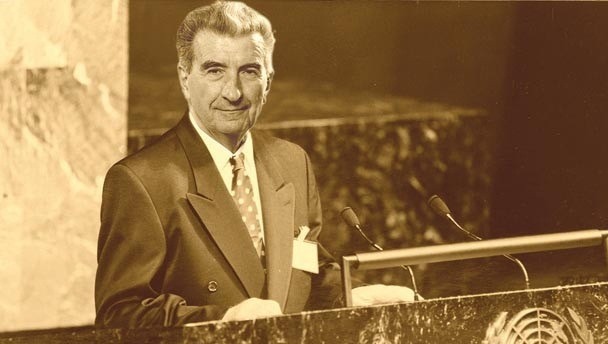
Newly declassified material attributed to US intelligence reporting from the early 1990s is being cited in local coverage as claiming that Kiro Gligorov, North Macedonia’s first president, rejected a $100 million offer from Greek officials that was allegedly conditioned on the country changing its name. The documents are presented as part of a broader set of assessments describing the diplomatic pressure and regional instability faced by the newly independent state, alongside internal political and ethnic challenges.
According to the reporting, the declassified document is dated November 1992 and portrays Gligorov as a careful and strategic political figure navigating overlapping risks: pressure from Greece over the name issue, uncertainty linked to Belgrade in the aftermath of Yugoslavia’s breakup, and domestic tensions involving ethnic-community relations and party competition. In the intelligence assessments cited, Gligorov is described as a “wise reformer” with close attention to strategic detail.
The central claim highlighted in multiple articles is that, despite serious economic difficulties at the time, Gligorov refused a private offer of $100 million allegedly made by Greek representatives, with the stated condition that Macedonia change the name of the state. The accounts say Gligorov characterized the Greek demands as unreasonable and argued that the country had already provided sufficient evidence that it held no territorial claims toward its neighbors. The same reporting adds that he voiced disappointment with the European Community’s posture, which was described as supporting Greece’s veto approach in that period.
Beyond the name dispute, the coverage says the declassified reporting also describes Gligorov’s approach toward Serbia and the remaining Yugoslav structures after secessions. The document is cited as stating that, while he maintained communication with Belgrade, he rejected efforts to persuade Macedonia to join a new association with what remained of Yugoslavia under Serbian dominance. It further claims he did not trust Slobodan Milošević and viewed Milošević—along with Croatia’s Franjo Tuđman—as among the principal actors behind the bloody crisis in the former Yugoslavia.
The reporting also says Gligorov’s authority is described as a key stabilizing factor at home at a time of fragile coalition politics and heightened interethnic sensitivities. The declassified assessments cited point to internal challenges in balancing relations with the country’s larger ethnic Albanian community and in managing confrontation with right-wing political forces. The same accounts add that his strategy emphasized individual rights over collective claims—an approach portrayed as more acceptable to moderate Albanian leaders, even amid criticism that the state was insufficiently responsive.
Finally, the articles state that the declassified material describes Macedonia’s early effort to strengthen external partnerships as a buffer against instability. Gligorov is said to have worked to deepen ties with Bulgaria and Turkey, while seeking political support from major Western powers, including the United States, the United Kingdom, and France, positioning international backing as important for safeguarding the country’s stability and sovereignty during its first years of independence.