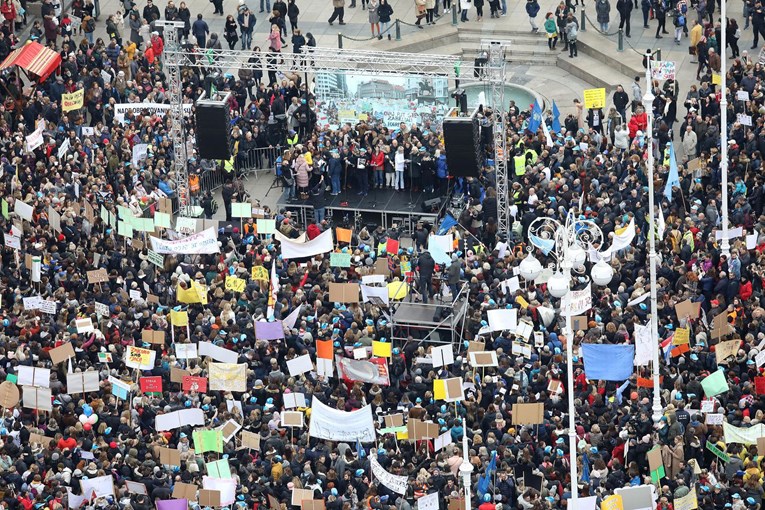
Three major trade union confederations, together with the Union of Pensioners of Croatia, have announced a large protest in Zagreb for Saturday, April 18, under the slogan “Croatia Together for Higher Wages and Pensions.” The gathering is scheduled for noon at Ban Jelačić Square, while the march is set to begin at 11 a.m. in front of the Croatian National Theatre. Organizers said they expect more than a hundred buses from across the country and called on workers, pensioners, and other citizens to join.
Union demands on wages and pensions
Union leaders said the protest is centered on demands for a net minimum wage of 1,100 euros, an average wage of 2,200 euros, and an average pension of 1,100 euros. Mladen Novosel said the 2,200-euro target reflects what he described as the current European average net wage, while unions also insist that pensions should reach at least half of the average salary. The organizers tied these demands not only to wages and pensions but also to lower food and housing costs, as well as to fighting corruption and the grey economy.
Why unions say the protest is necessary
In presenting the protest, union representatives argued that rising prices have outpaced the value of labor and that daily life has become increasingly difficult for both workers and pensioners. Novosel said prices are rising across the market regardless of real costs and argued that the government has failed to respond adequately, while also insisting that there is room for higher pay because money remains in the private sector. He pointed to an example of a receptionist in Istria earning 1,150 euros for work under an Austrian owner, while, according to his comparison, the same owner pays 2,500 euros for the same job in Austria.
Claims about profits, wages, and housing pressure
Other union representatives expanded the argument by linking wage demands to broader living-standard pressures. Dražen Jović said 70 percent of workers in Croatia earn less than the average wage and stated that employers’ profits rose by 336 percent from 2015 to 2024, while wages in the same period rose by 72 percent. He also highlighted housing affordability, saying that two-thirds of workers earn less than 1,511 euros while the average square meter of housing costs more than 3,000 euros, concluding that a Croatian worker “cannot buy half a square meter of an apartment.” In the same tone, organizers said Croatia should not be viewed through “rose-colored glasses” but through inflation and the real financial hardship faced by citizens.
Pensioners are placed at the center of the protest message
Pension issues were presented as one of the main pillars of the rally. Višnja Stanišić said many pensioners, after just fifteen days of receiving their pension, are already checking how much money they have left and deciding whether they can afford only basic items. She said the protest is also intended to support demands for pension indexation changes, a different pension calculation model, the removal of what she described as discrimination against women, and the exclusion of social transfers from the pension system. Novosel also criticized the past removal of the “ten best years” pension calculation method, presenting that issue as part of the reason many pensions remain too low.
Public call for a wider social turnout
The unions repeatedly stressed that the protest is not meant only for organized labor but also for the broader public. Sanja Šprem said everyone should come, regardless of whether they work in the public or private sector, because the price of labor is falling while living costs, especially food prices, have risen sharply in recent years. Organizers framed the gathering as a message that “this can no longer continue,” saying citizens deserve to live better and deserve a better Croatia.
Employers’ association pushes back
The Croatian Employers’ Association responded critically to the unions’ demands. HUP director general Irena Weber said unions calling for an average wage of 2,200 euros should show greater responsibility, arguing that employee costs in the state budget have reached their limits. She said wages in the public and state sectors had risen by 51 percent in the last two years and argued that, in conditions of low productivity, limited profitability, and geopolitical uncertainty, it is not the right path to increase macroeconomic tensions further. She also said the private sector cannot finance such a large public spending burden.
HUP says reforms must come first
HUP’s response went beyond rejecting the numbers alone and framed the issue as structural. Weber said the public and state sector is oversized and described that as unsustainable in the long term, while warning of a historically large pay gap of around 600 euros between the state and public sector. Economist Hrvoje Stojić, cited in the same reaction, said that if the basis for investment in productivity keeps being undermined, it will not be possible to finance such wage growth over the long term. HUP’s position, as presented in the coverage, is that higher wages are possible only through reforms, stronger productivity, and a faster and more efficient administration.