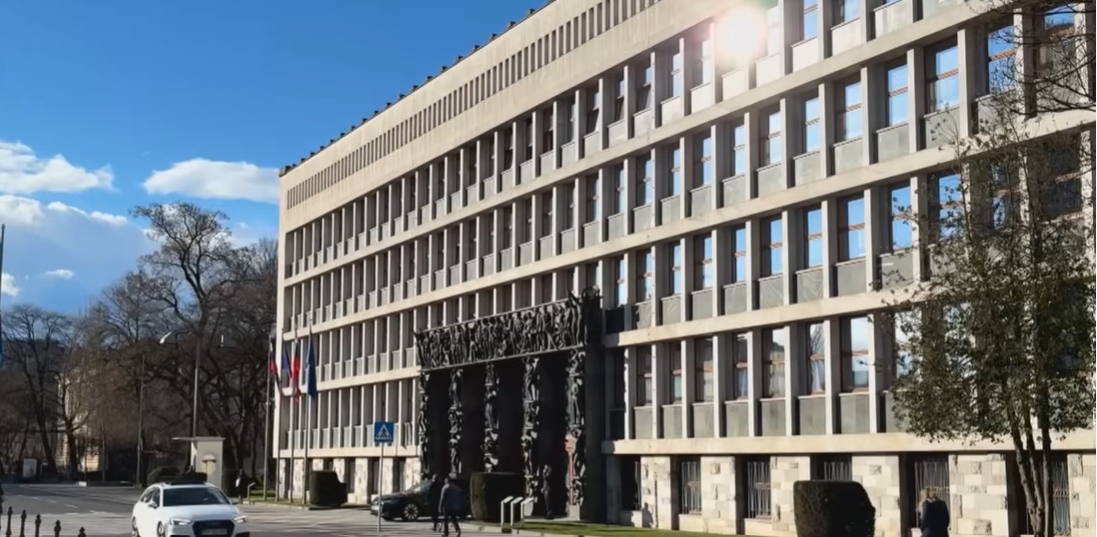
Efforts to form a new government in Slovenia have run into immediate difficulty after President Nataša Pirc Musar said, following her first round of consultations with parliamentary group leaders, that no one currently has the 46 votes required to secure the mandate to form a government in the National Assembly. The reports describe the situation as one in which consultations are continuing because there is still no candidate with a real and verifiable parliamentary majority.
Although the constitutive session of parliament had raised speculation that SDS leader Janez Janša could emerge as the prime minister-designate, the reports say he stated after meeting the president that his party is not currently forming a government. At the same time, he said SDS is prepared for all scenarios, whether that means remaining in opposition, forming a government, or facing new elections. On the other side, outgoing Prime Minister and Freedom Movement leader Robert Golob said he is looking forward to working in opposition, while also describing a possible right-wing coalition as a “coalition of deceivers” that he believes would not last long.
The reports emphasize that President Pirc Musar has not ruled out proposing a candidate for prime minister-designate, but made clear that she does not want to make a merely formal move without a solid parliamentary basis. According to the coverage, her message is that talks will continue until it becomes clear whether anyone can provide stable backing. In that sense, Slovenia is portrayed not as being at the stage of proclaiming a new government, but rather at the stage of counting secure votes and testing whether a workable majority actually exists.
The post-election arithmetic remains uncertain even beyond the main party leaders. The reports note that Slovenian media have floated possible names for a third candidate for the mandate, outside the leaders of the two biggest parliamentary parties, but stress that such a scenario is also uncertain because it would still require the same threshold of 46 votes in parliament. That leaves the process open-ended, with no definitive outcome yet visible despite the initial round of consultations.
The constitutional timetable now becomes especially important. According to the reports, the president can propose a candidate for prime minister-designate no later than 30 days after the constitutive parliamentary session, meaning by May 10. If sufficient support does not materialize, she may also decide not to propose a candidate in the first round, after which the process would continue with new opportunities for nominations either from parliamentary groups or from at least ten deputies. The overall picture presented in the articles is one of prolonged uncertainty rather than imminent government formation.
Taken together, the reports depict Slovenia as entering a delicate post-election phase in which no bloc has yet converted political momentum into a functioning majority. The president’s consultations have confirmed that the key problem is not the lack of names, but the lack of 46 reliable votes. Until a candidate appears who can demonstrably gather that support, the prime minister-designate remains uncertain and the formation of a new Slovenian government remains an unresolved political equation.