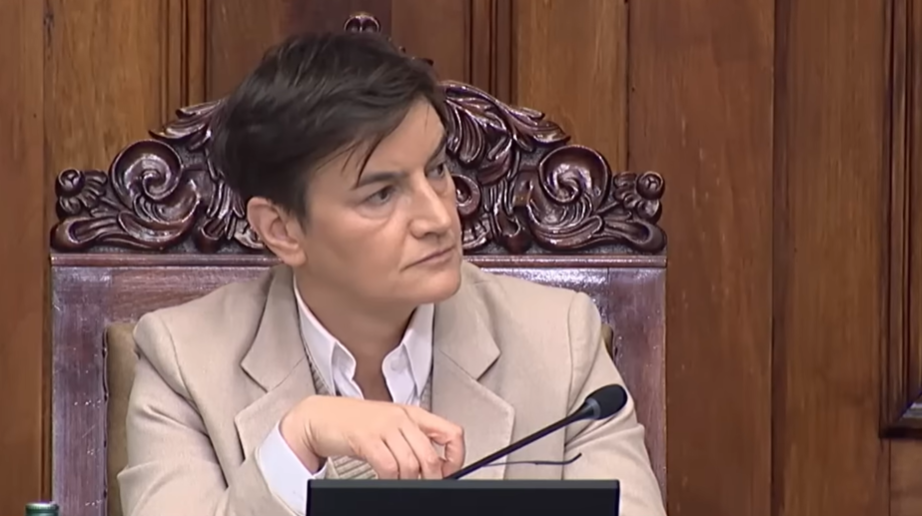
Tensions escalated sharply in the Serbian parliament during a heated exchange involving Ana Brnabić and an opposition MP, with the confrontation quickly drawing public attention due to its tone and the nature of the remarks made during the session. According to the reports, the incident occurred amid an already tense parliamentary atmosphere, with verbal exchanges intensifying between members of the ruling majority and the opposition.
At the center of the confrontation was a remark by the MP that referenced Brnabić in a personal manner, prompting a direct and visibly firm response from the prime minister. In her reply, Brnabić stated that the fact that both she and the MP are gay “does not mean that we are on informal terms,” rejecting what she interpreted as an inappropriate attempt at familiarity. The reports describe her reaction as sharp and immediate, with the statement becoming the focal point of the exchange and widely circulated in media coverage.
The situation is portrayed as part of a broader pattern of rising tensions in parliamentary debates, where political disagreements are increasingly accompanied by personal remarks and confrontational rhetoric. The exchange between Brnabić and the MP is presented as an example of how discussions in the assembly have shifted from policy disagreements to more personal and emotionally charged interactions.
Several reports emphasize that the incident triggered reactions both within and outside the parliament, with attention focused not only on the political disagreement but also on the tone of the communication. The coverage frames the moment as a “low blow” in the parliamentary debate, underlining the perception that the exchange crossed the boundaries of standard political discourse.
Taken together, the reports depict the incident as a reflection of a highly polarized political environment in Serbia, where institutional debates are increasingly marked by sharp language and personal confrontations. The clash involving Brnabić is therefore presented not as an isolated moment, but as part of a wider trend of heightened tensions within the country’s legislative body.