Scientists are examining one of the most ambitious climate engineering ideas ever proposed: building a massive barrier across the Bering Strait, the narrow passage between Russia and Alaska.
The goal would be to help protect the Atlantic Meridional Overturning Circulation, known as AMOC, a major ocean system that plays a crucial role in regulating the planet’s climate. A collapse of this current could bring severe consequences, particularly for Northern Europe, where temperatures could drop sharply and weather patterns could become far more unstable.
The proposal may sound like science fiction, but new research published in Science Advances suggests that closing the Bering Strait could, under certain conditions, temporarily slow the weakening of this vital ocean circulation system. At the same time, the researchers warn that such an intervention would carry serious environmental, technical and political risks.
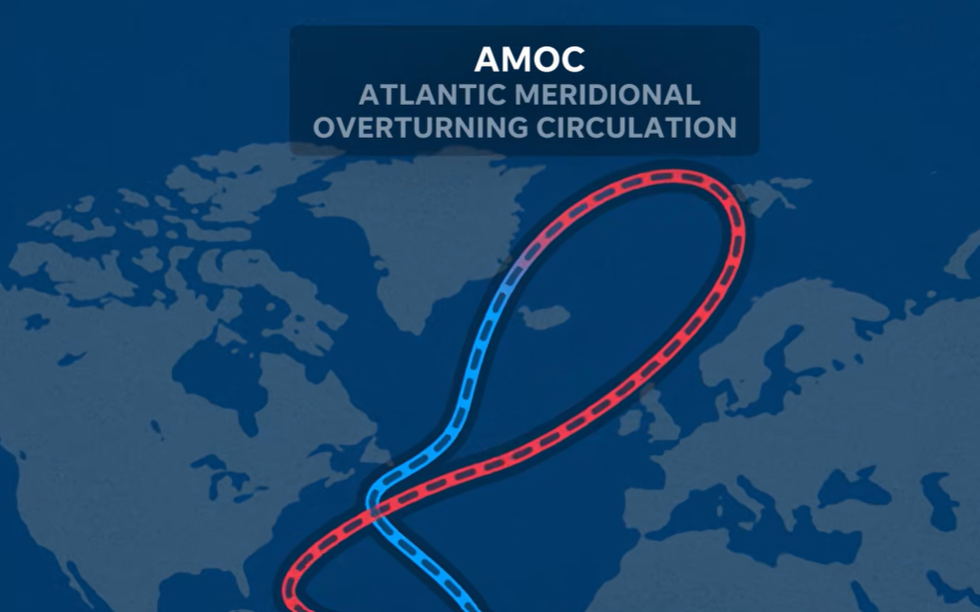
AMOC functions like a vast ocean conveyor belt. It moves warm, salty water from the tropics toward the North Atlantic, where the water cools, sinks and flows back south as a colder current. This circulation supports marine ecosystems and strongly influences the climate of Europe, Africa and the Americas. It is one reason Europe has a milder climate than other regions at similar northern latitudes.
In recent years, scientists have become increasingly concerned that AMOC is losing strength. Some studies suggest that by 2100, the system could weaken by between 43 and 59 percent, a decline more severe than earlier climate models had projected.
The possible consequences would be far-reaching. Northern Europe could face much colder conditions, drought risks could increase in several regions, sea levels along the northeastern coast of North America could rise significantly, and global food production could come under pressure.
Researchers point to two major ways in which global warming threatens AMOC. First, rising temperatures in the North Atlantic make it harder for warm, salty water to cool and sink. Second, melting ice sheets release large amounts of freshwater into the ocean, reducing salinity. Less salty water is lighter and does not sink as easily, weakening the entire circulation system.
The idea of closing the Bering Strait was inspired by Earth’s distant past. Around three million years ago, during the mid-Pliocene period, the Bering Strait was blocked by a land bridge. At that time, AMOC was stronger. That historical example led scientists to ask what might happen if the passage were closed again.
To fully block the Bering Strait today, researchers estimate that three separate dams would be required because two islands sit in the middle of the passage. The strait is around 82 kilometers wide, while the longest individual dam would need to stretch approximately 38 kilometers. The structure would also have to reach depths of around 59 meters.
From an engineering perspective, scientists say such a project may be technically possible. Similar large-scale sea barriers already exist in the Netherlands and South Korea. However, the Bering Strait presents far greater challenges. The region is remote, icy, exposed to strong currents and located between two major powers, Russia and the United States, making any project politically extremely complicated.
Even if such a dam could delay AMOC collapse, researchers stress that it would not solve the root cause of the problem: global warming. At best, it could buy time under specific conditions. It would not remove the long-term danger created by rising greenhouse gas emissions.
For that reason, scientists say the most reliable way to protect AMOC remains the reduction of greenhouse gas emissions. Further research, climate modelling and environmental assessments would be needed before any proposal of this scale could be seriously considered.
For now, the concept of a giant dam between Russia and Alaska remains a striking scientific possibility — and a reminder of how deeply climate change is beginning to affect the natural systems on which billions of people depend.