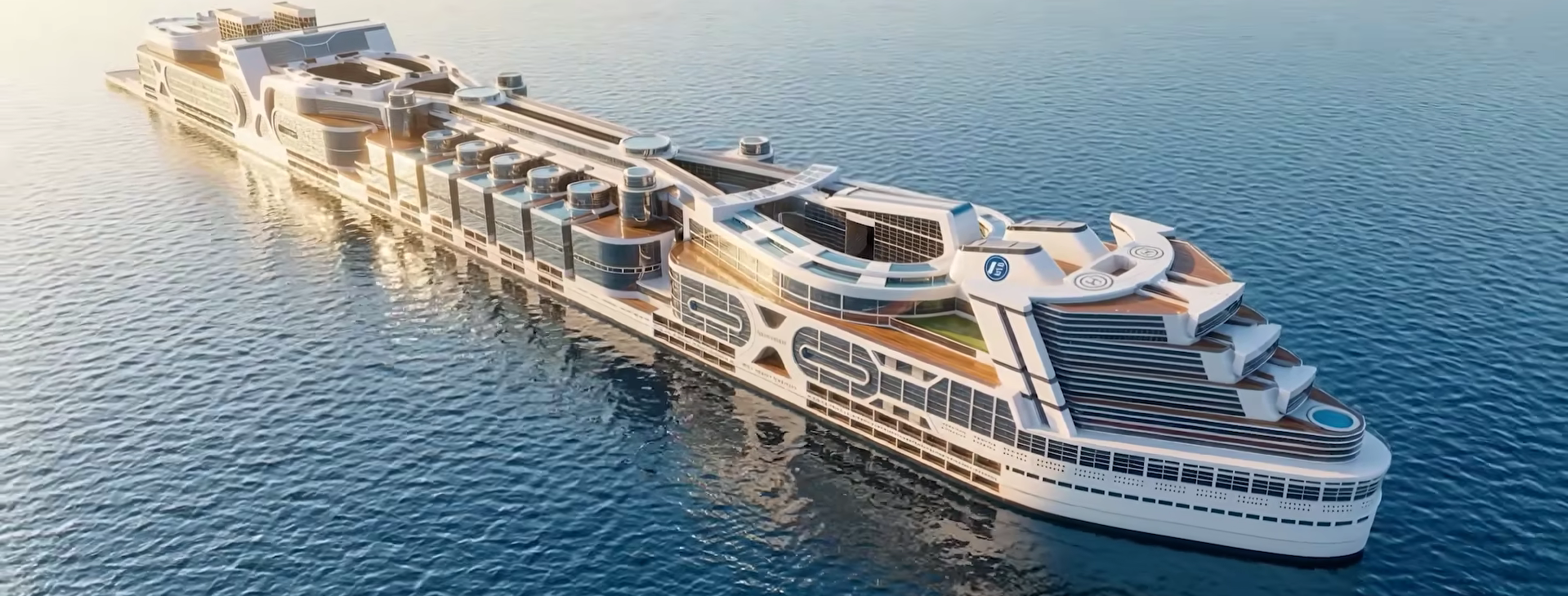
A decades old vision of a permanent floating city is being revived by a new team, with plans for a 1.6 kilometer (1 mile) vessel that would house 50,000 permanent residents, 10,000 visitors, and 20,000 crew members while continuously circling the globe. The Freedom Ship concept, first proposed in the late 1990s by American engineer Norman Nixon, is now being led by Roger Gooch, executive director of Freedom Cruise Line International, who claims interest is strong enough to justify building three such vessels. The project envisions a self contained urban environment with schools, hospitals, hotels, shops, a 15,000 seat stadium, an aquarium, and eight helipads, all powered by nuclear energy and connected by an internal tram system.
The sheer scale of the vessel dwarfs anything currently afloat. At 1,371 meters (4498 feet) long, 228 meters (748 feet) wide, and 25 storeys high, Freedom Ship would be more than eight times larger than Royal Caribbean’s current flagship, the Star of the Seas. It would never enter a port, its size makes that impossible, so passengers and supplies would arrive via smaller vessels and ferries while the ship remains in international waters. The plan calls for construction in Indonesia, with the vessel built in segments that would be assembled at sea over three to four years. Residents could move in during construction, and maintenance would be performed while the ship is underway. Gooch emphasizes that the ship “will never have a home port,” functioning instead as a sovereign maritime community with its own governance, economy, and regulatory framework.
The concept has a long history of false starts. Nixon first unveiled the idea in the 1990s, with estimated costs rising from $6 billion in 1999 to $11 billion by 2002. The project was resurrected after Nixon’s death in 2012, then shelved again amid financing difficulties. Today’s revived version carries a price tag of roughly £12 billion ($15 billion) and faces the same fundamental challenges, naval engineers have long warned that current techniques are inadequate for vessels of this size, with hull stresses from hogging and sagging in heavy seas posing catastrophic failure risks. The original design called for 400 fully rotational azipods to propel the ship at roughly 13 kilometers(8 miles) per hour, making it the slowest vessel in the world despite its enormous power plant. Chief architect Kevin Schofield, an expert in arcology, says the new design will soften harsh lines with green spaces and promenades to create a more natural living environment, and the project’s backers tout nuclear propulsion and ocean cleaning capabilities as environmental selling points.
For all its ambition, Freedom Ship remains firmly in the realm of concept rather than construction. Only two residential cruise ships, The World and the more accessible Villa Vie Odyssey, have ever made the floating city model work in practice, and both operate at a fraction of the proposed scale. The project’s original appeal included tax haven status for registered residents, a feature that drew skepticism even in the freewheeling 1990s. Whether Gooch can secure the billions in financing required, overcome the engineering barriers that have defeated supertanker builders, and convince 50,000 people to gamble their lives on a vessel that cannot seek shelter in any harbor will determine whether Freedom Ship finally sets sail or remains, like Jules Verne’s propeller island, a captivating fiction of maritime imagination.