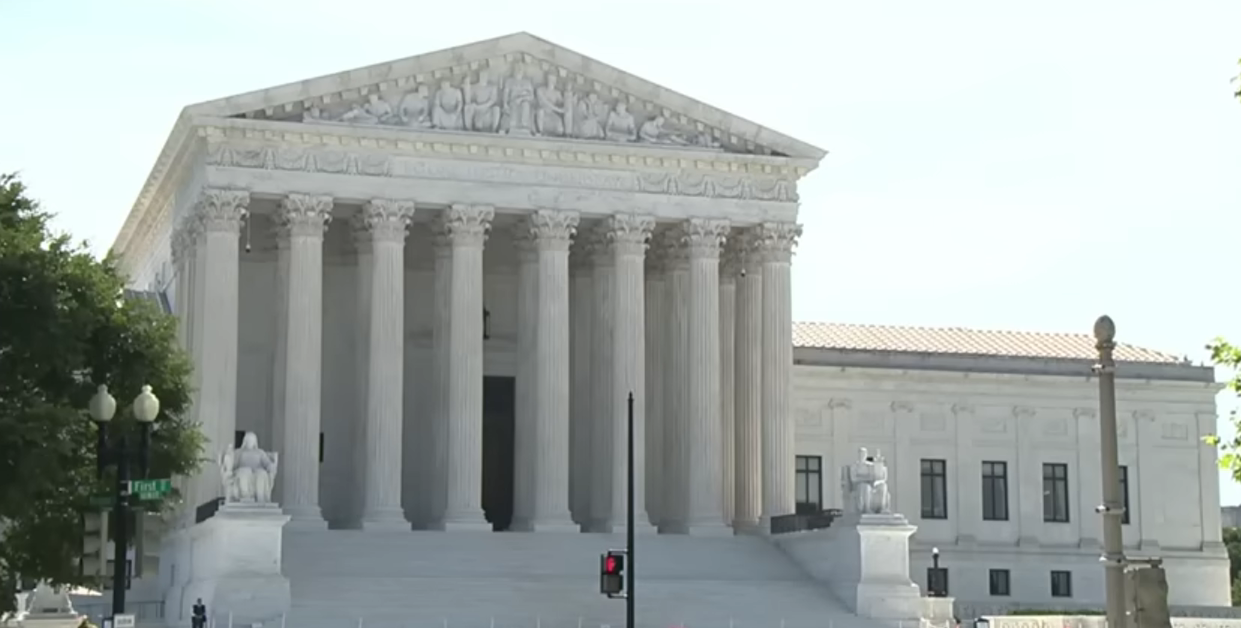
The US Supreme Court handed President Donald Trump a major immigration victory on Thursday, ruling 6-3 that federal officials may turn away asylum seekers at the US-Mexico border when crossings are deemed too overburdened to process additional claims. The decision, authored by conservative Justice Samuel Alito, overturned a lower court ruling that had found the so called “metering” policy violated federal law requiring inspection of all migrants who “arrive in the United States.” Alito concluded that asylum seekers stopped on the Mexican side of the border have not, in “ordinary speech,” arrived in the country, writing that “no one would say that a person ‘arrives in’ a place before the person enters that place.” The ruling gives the Trump administration authority to revive a practice first implemented under Barack Obama in 2016, formalized by Trump in 2018, and rescinded by Joe Biden in 2021.
The decision was one of two immigration rulings issued by the court on Thursday that sided with the administration. In the second case, also authored by Alito, the court cleared the way for the government to strip Temporary Protected Status from more than 350,000 Haitians and 6,100 Syrians, removing humanitarian protections that had shielded them from deportation. The metering ruling drew a blistering dissent from Justice Sonia Sotomayor, who took the unusual step of reading her dissent from the bench, a signal of profound opposition. Joined by Justices Elena Kagan and Ketanji Brown Jackson, Sotomayor warned that the consequences would be “predictable”: “More people will die. More people will attempt to cross the border illegally, and some will make it while others will not.” She accused the majority of authorizing immigration officers to refuse asylum applications by “physically blocking applicants from stepping foot onto US soil.” Alito then responded from the bench with an additional defense, noting he would have included more in his opinion summary had he known Sotomayor intended to air her dissent in court.
The legal battle over metering has been running since 2017, when the advocacy group Al Otro Lado launched a challenge arguing that federal law requires border agents to inspect all asylum seekers who arrive at designated crossings, regardless of whether they have physically crossed into US territory. The San Francisco based 9th US Circuit Court of Appeals agreed in 2024, ruling that the policy violated the statutory obligation to inspect all arrivals. The Supreme Court’s reversal now establishes that the government has broad discretion to control the pace of asylum processing at its borders. Department of Homeland Security General Counsel James Percival welcomed the ruling, saying it “opens up an important tool to continue securing our southern border” and vindicated the principle that “an alien is not ‘in the United States’ until he is, in fact, in the United States.” Plaintiff attorney Melissa Crow countered that the decision “should sound the alarm for anyone who cares about human rights and the rule of law,” suggesting it empowers the president to “unilaterally override decades of established law.”
The ruling arrives amid a broader conservative push to reshape US immigration policy. The court has previously backed Trump on an emergency basis in cases allowing deportation of migrants to third countries and revocation of temporary legal status for hundreds of thousands of Venezuelans. A decision on Trump’s directive to restrict birthright citizenship is expected by the end of June. The metering policy itself is distinct from the sweeping asylum ban Trump announced upon returning to office last year, which faces a separate ongoing legal challenge. For the administration, the Supreme Court’s blessing provides both a practical tool for border management and a judicial endorsement of its hardline approach. For critics, it represents another step in what Sotomayor called a “predictable” pattern of human costs, more deaths in the desert, more dangerous crossings, and more people turned back to face violence they fled. With the 9th Circuit’s ruling erased and the policy framework validated, the question is no longer whether the administration can meter asylum claims, but how aggressively it will choose to do so.