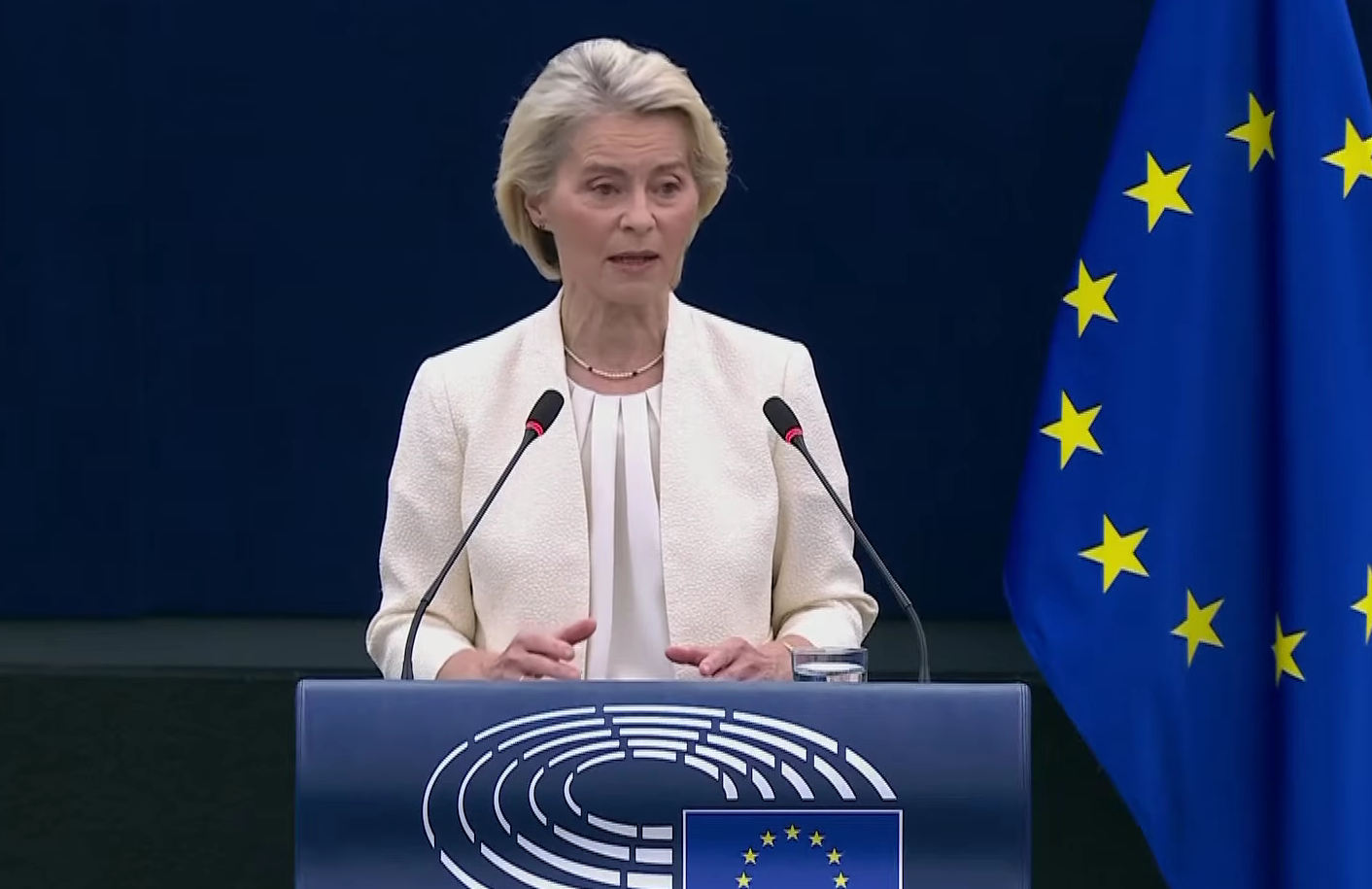
European Commission President Ursula von der Leyen is visiting Macedonia as the European Union signals a renewed push to bring Western Balkan countries closer to membership through gradual integration and continued reforms. Her visit to Skopje comes amid fresh discussions in Brussels about offering candidate countries more opportunities to participate in EU structures before full membership. For Macedonia, the developments bring renewed attention to its long running accession process, the reforms it must complete and the political decisions that will shape its next steps toward the European Union.
The visit is part of von der Leyen’s annual tour of the Western Balkans, which also includes Albania, Kosovo and Montenegro. In Skopje, she is scheduled to meet Prime Minister Hristijan Mickoski and President Gordana Siljanovska Davkova. The European Commission has said the tour is focused on the next stages of accession preparations and the gradual integration process, supported by the EU’s €6 billion Growth Plan for the Western Balkans. Von der Leyen is also expected to visit the railway Corridor VIII project, highlighting the role of EU supported infrastructure in regional connectivity.
The visit takes place as European Commissioner for Enlargement Marta Kos outlines new ideas for expanding gradual integration. Speaking at a Berlin Process meeting in Montenegro, Kos said the European Commission plans to present additional proposals on October 6. The approach is based on offering countries more opportunities to benefit from cooperation with the EU before becoming full members. Kos emphasized, however, that gradual integration is not intended to replace accession. She argued that geopolitical considerations and the principle of merit based enlargement can work together, with progress continuing to depend on each country’s ability to meet the required standards.
Kos also stressed the importance of regional cooperation, reconciliation and stronger relations between neighboring countries. She described enlargement as a strategic issue linked not only to economic development but also to Europe’s security and resilience. In her view, closer cooperation can help reduce historical divisions and strengthen stability across the region. The message is particularly relevant to the Western Balkans, where unresolved bilateral issues and differing levels of progress continue to influence the accession process.
German Foreign Minister Johann Wadephul delivered a similar message at the Berlin Process meeting, stating that the Western Balkans belongs in the European Union. He described enlargement as an important test of the EU’s influence and future role in Europe. Wadephul also pointed to the Berlin Process as a platform for supporting regional cooperation and encouraging countries to take responsibility for reforms. A German-French non paper proposing additional incentives for gradual integration has also contributed to discussions about how the enlargement process could gain momentum while remaining based on established conditions.
Gradual EU Integration and the Western Balkans
Across the region, countries are moving at different speeds. Albania has made progress in its accession negotiations, opening its final negotiating cluster and closing several chapters, according to developments described during von der Leyen’s regional tour. Montenegro has also advanced in its negotiations and is increasingly discussed as a country approaching the later stages of the accession process. These developments have renewed attention to the different positions of Western Balkan countries and the importance of meeting EU requirements rather than relying solely on geopolitical arguments.
Macedonia’s position remains more complicated. The country has been an EU candidate for many years, but the next stage of negotiations is linked to a constitutional amendment commitment concerning the inclusion of the Bulgarian community in the Constitution. During her previous visit in October 2025, von der Leyen reiterated that this change was the remaining step before negotiations could begin. The issue continues to shape domestic political debate, with the government and opposition differing over the conditions, timing and consequences of moving forward.
Ahead of von der Leyen’s visit, Social Democratic Union of Macedonia leader Venko Filipche urged Prime Minister Mickoski to use the meeting to clarify the government’s position on European integration. Filipche argued that Macedonia risks falling further behind countries such as Albania and Montenegro and criticized what he described as policies that could leave the country isolated. He also referred to a possible 2030 membership horizon for several countries, including Albania, Montenegro, Ukraine and Moldova. These remarks represent the opposition leader’s political assessment; EU membership timelines remain dependent on negotiations, reforms and decisions by EU institutions and member states.
The EU’s gradual integration approach could offer Macedonia practical benefits even before full membership. Through the Growth Plan and its Reform and Growth Facility, the country can receive financial support linked to progress in areas such as governance, public administration, the rule of law, economic development and the green and digital transitions. In July 2026, the EU Delegation said Macedonia had received €142.1 million following progress under its Reform Agenda. Such support can help fund reforms and bring some benefits of closer European cooperation to citizens and businesses, although it does not remove the political and legal requirements for accession.
The wider debate is therefore about more than the timing of EU membership. It also concerns how candidate countries can participate more closely in the single market, improve transport and economic links, strengthen institutions and create opportunities for their citizens while negotiations continue. For Macedonia, progress in these areas may provide tangible benefits, but the country’s long term accession path still depends on addressing outstanding conditions and maintaining the reforms required by the EU.
Von der Leyen’s visit comes at a moment when European enlargement is receiving renewed strategic attention, while the countries of the Western Balkans continue to face different political and institutional challenges. The proposals expected from the European Commission on October 6 could provide further detail about what gradual integration might mean in practice. For Macedonia, the central questions remain how to translate closer cooperation into concrete benefits and how to resolve the outstanding issues that stand between the country and the next stage of EU accession. The visit offers an opportunity for discussion, but any significant change in the country’s membership prospects will depend on decisions and reforms that extend beyond a single diplomatic meeting.