Slovenia’s parliamentary election ended without a clear governing majority, sending the country into what is expected to be a difficult coalition-building process after Prime Minister Robert Golob’s liberal Freedom Movement (GS) narrowly finished ahead of Janez Janša’s Slovenian Democratic Party (SDS). With almost all votes counted, GS won 29 seats and SDS 28 seats in the 90-member parliament, leaving both blocs short of the 46 seats needed for a majority.
The result confirmed an exceptionally tight race that many reports described as politically fragile. Preliminary vote shares placed the two main parties almost level, and the final seat distribution turned on extremely small margins. In local coverage reflected in your links, that narrowness was illustrated through references to a difference of only a few dozen votes in parts of the count, reinforcing the broader picture of an election with no decisive winner. The overall outcome points to a parliament split almost evenly between Slovenia’s liberal pro-European camp and its conservative-populist right.
No majority, no quick resolution
Because neither of the two leading forces can govern alone, the post-election focus has shifted immediately to coalition arithmetic. Reuters reported that when likely allies are counted, Golob’s side reaches about 40 seats, while Janša’s side reaches about 43, still below the threshold for forming a government. That leaves smaller parties in a kingmaker position and makes negotiations unavoidable.
This is why much of the reporting framed the result not as a clean victory for either side but as the opening of a new phase of political uncertainty. President Nataša Pirc Musar called on parties to begin government-formation talks urgently, while reports described the next steps as potentially long and complex. The election therefore, ended not with a resolved mandate, but with a fragile balance that may test Slovenia’s coalition culture and political stability.
Golob claims victory, but his position remains fragile
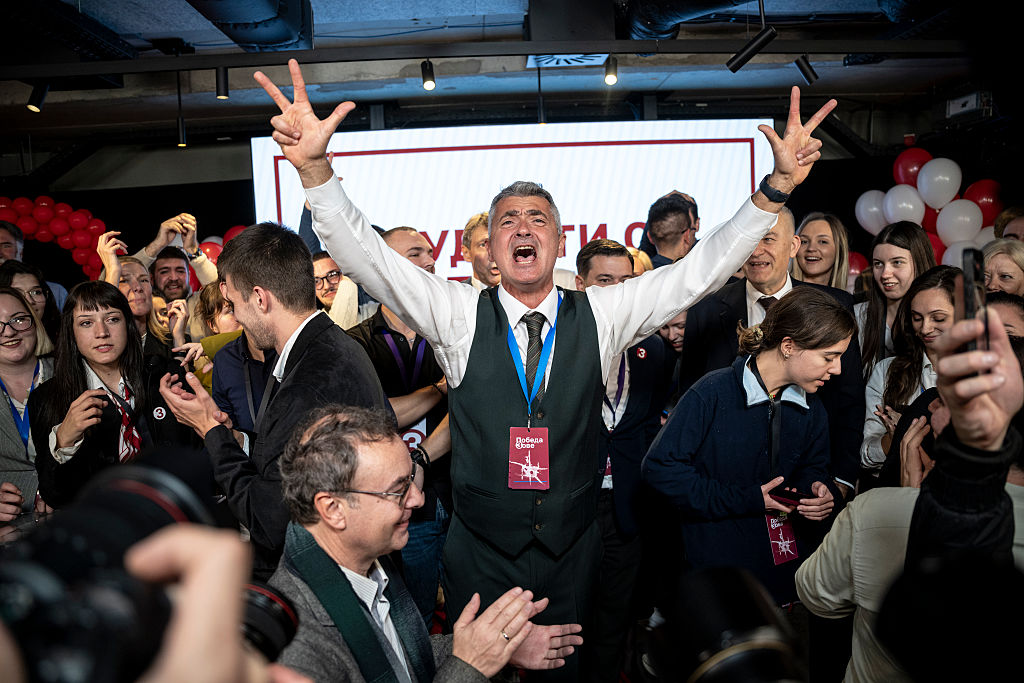
Golob emerged as the relative winner of the election and publicly presented the result as a mandate to continue his policy course. Reports say he expressed readiness to negotiate with democratic parties in order to advance his agenda, which has been associated with healthcare, education and economic reform. But the same reports also stress that his lead is minimal and that his path to a new government is far from secure.
That is why several of the articles you shared described his victory as “fragile.” Formally, he finished first. Politically, however, he still has to prove he can convert that narrow advantage into a workable parliamentary majority. In practical terms, his election success did not remove uncertainty; it merely gave him the first chance to try to assemble a coalition.
Janša rejects defeat and questions the result
Janez Janša did not behave like a clearly defeated challenger after the vote. Reporting indicates that he signaled reluctance to support or join what he called a weak coalition and, in some coverage, questioned aspects of the vote-counting process. Reuters reported that Janša claimed, without presenting evidence, that discrepancies in counting had cost his party tens of thousands of votes.
That posture fed into the narrative, reflected in the Macedonian summaries you sent, that Janša was not simply accepting the outcome as a straightforward loss. Instead, he projected the message that the result remained politically contested and that instability might follow. This hardened stance is one reason the election is being interpreted as a prelude to difficult negotiations rather than a routine transfer or renewal of power.
A deeply divided political landscape
The election confirmed how sharply divided Slovenian politics has become. International coverage described the vote as a choice between two distinct political directions: Golob’s liberal, pro-European line and Janša’s right-leaning, more nationalist and populist alternative. AP and Reuters both portrayed the result as evidence of a country split almost down the middle between those two visions.
That division was amplified by the campaign’s tone. The race unfolded after weeks of controversy involving allegations of corruption and foreign interference, themes that had already destabilized the campaign environment before voters went to the polls. The closeness of the final result means those tensions are now likely to carry over into the government-formation period.
Coalition talks have now become the decisive battleground
The election did not settle who would govern Slovenia; it only determined who would enter coalition talks from a slightly stronger starting point. Golob has the symbolic advantage of coming first, but Janša’s bloc is also close enough in parliamentary weight to remain highly relevant in the next phase. Much now depends on the smaller parties that crossed the electoral threshold and on whether either of the two main camps can build a coalition broad enough to reach 46 seats.
As a result, the main political story after the election is no longer the vote count itself but the negotiations that follow. The reports consistently suggest that Slovenia may now face a prolonged and uncertain coalition process, with the possibility of instability if no durable parliamentary arrangement emerges.
What the result means
Taken together, the election produced a formally narrow win for Robert Golob but no decisive governing mandate. Freedom Movement finished first by one seat, Janez Janša’s SDS remained almost level with it, neither side secured a majority, and smaller parties now hold the balance of power. The immediate consequence is a new period of coalition bargaining in which every seat matters and every alliance will be scrutinized. In that sense, the vote did not close Slovenia’s political contest; it opened its most difficult phase.