Serbia marked the 27th anniversary of the start of the NATO bombing of the then Federal Republic of Yugoslavia, which began on March 24, 1999, and lasted 78 days until the Kumanovo Agreement. Reports in the Serbian media again placed the anniversary at the center of public and political attention, with coverage focusing both on remembrance and on the continuing dispute over how the campaign should be interpreted.
There are some differences in the way the start of the operation is timed in the coverage. One report says the first bombs fell near Priština at 19:41, while another places the start at 19:53. Both, however, agree on the date, the beginning of the air campaign on March 24, 1999, and the fact that it lasted 78 days.
Two sharply different interpretations of why the bombing began
One line of reporting, reflected in Serbian anniversary coverage, presents the bombing as an aggression carried out without authorization from the UN Security Council, with the stated Western justification tied to events in Kosovo, including Račak and the failed Rambouillet and Paris talks. This interpretation also stresses that Serbia rejected the stationing of foreign troops on its territory and proposed a UN-supervised peace solution before the airstrikes began.
A contrasting framing appears in the Radio Free Europe coverage, which describes March 24 as the anniversary of NATO bombing of Serbian military and police targets in former Yugoslavia, launched in order to stop violence by Serbian forces against Albanians in Kosovo after failed international efforts to secure a ceasefire from Slobodan Milošević. That report also notes that NATO Secretary General Javier Solana approved the strikes and that this was the first time NATO used force without UN Security Council approval.
What was hit during the campaign
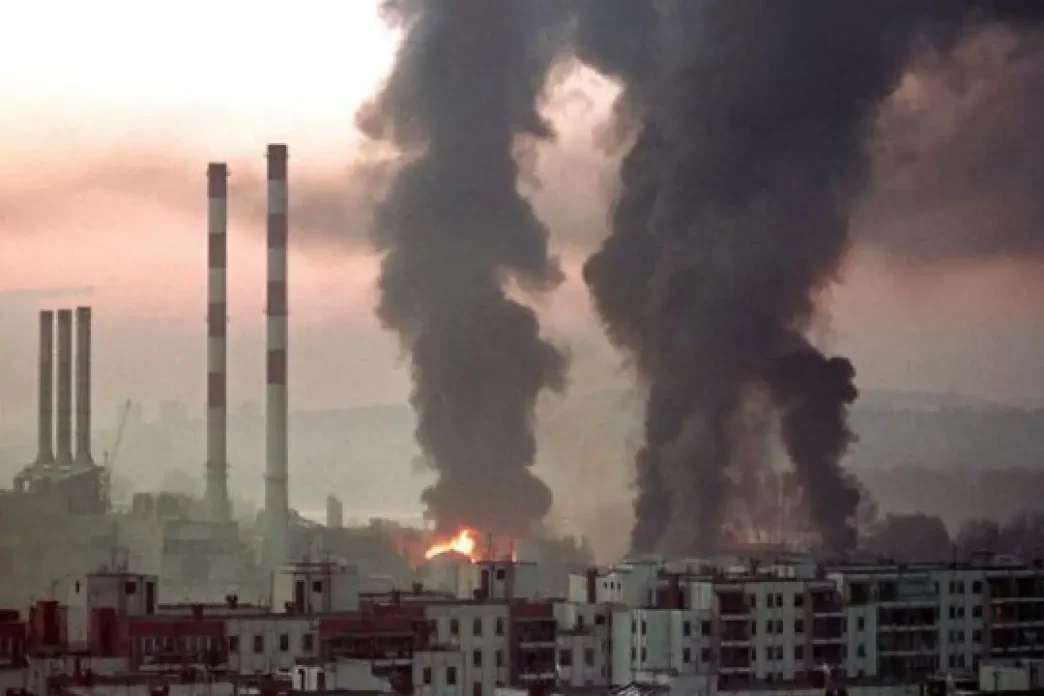
Serbian reporting emphasizes that the bombing did not remain limited to military targets. One article says that during the two-and-a-half-month campaign, not only military objectives, barracks and installations were struck, but also hospitals, factories, bridges, railways, media facilities, transmitters, fuel depots and broader energy infrastructure. The same report says the last bombs fell on June 10, 1999, in the village of Koločelo/Kololeč in the municipality of Kosovska Kamenica.
The Radio Free Europe article, while describing the operation in terms of Serbian military and police targets, also notes the scale of the campaign: around 1,000 aircraft, more than 38,000 sorties, including 10,484 combat missions, launched from bases in Italy and Germany and from the aircraft carrier USS Theodore Roosevelt in the Adriatic.
Casualties remain one of the most disputed issues
The anniversary reporting shows that casualty figures remain contested. One Serbian source, citing Serbia’s Ministry of Defense, states that 1,031 members of the army and police were killed, 5,173 wounded, around 2,500 civilians were killed, including 89 children, around 6,000 civilians were wounded, including 2,700 children, and 25 people are still listed as missing.
Other reporting presents a much wider range. N1 says the precise number of those killed has never been definitively established, with estimates ranging from 1,500 to several thousand. The same report adds that the Humanitarian Law Center and the Humanitarian Law Center Kosovo estimated 754 directly identified deaths caused by NATO bombs. Radio Free Europe, meanwhile, situates the war’s broader end result at around 13,000 dead, thousands of missing, hundreds of thousands of refugees, and thousands of damaged or destroyed structures. These are not identical measures, and the coverage itself makes clear that different institutions and outlets count the losses in different ways.
Serbian remembrance narrative: illegality, sacrifice, and Kosovo
In the Serbian anniversary framing, the bombing is repeatedly described as a presedan and as an attack carried out without UN Security Council consent. Some reports strongly connect the anniversary to Kosovo and Metohija, arguing that the conflict of 1998 and 1999 was misrepresented internationally and that the Kosovo Liberation Army was responsible for a series of attacks before the NATO operation. In this version of the story, Račak and the breakdown of Rambouillet are presented as pretexts rather than legitimate triggers.
This narrative also links the anniversary to a longer-lasting political message about Kosovo. In one text, the bombing is placed within a broader patriotic interpretation centered on Serbian resistance, military sacrifice, and the enduring slogan that “Kosovo is Serbia.”
The Kosovo-focused international framing
The Radio Free Europe report reflects a different emphasis, placing the bombing in the context of efforts to stop violence against Kosovo Albanians and describing NATO’s targets specifically as Serbian military and police structures. It also notes that after the campaign, KFOR began deploying on June 12, 1999, initially with around 50,000 troops, while today it numbers 4,767 personnel from 33 countries.
This framing places the anniversary less in the register of Serbian national suffering and more in the context of the Kosovo conflict, international intervention, and the military-political consequences that followed.
Russian reaction on the anniversary
The anniversary also brought an official Russian statement, reported in Serbian media, in which Russia’s Foreign Ministry said the long-term consequences of NATO’s 1999 action against Yugoslavia are still being felt. According to that report, Moscow described the campaign as a tragedy, said the United States and its allies carried out rocket and bombing attacks on populated areas and civilian infrastructure during the 78 days, and argued that nobody in NATO was punished, while victims were dismissed as “collateral damage.”
That reaction fit into the broader Serbian commemorative tone, in which the anniversary is not treated as a closed historical episode but as an event with lasting political, legal and moral consequences.
An anniversary that still divides historical memory
Taken together, the coverage shows that the anniversary of the NATO bombing remains one of the most contested dates in the region’s recent history. Serbian and pro-government narratives continue to frame the campaign primarily as an illegal act of aggression against a sovereign state, with emphasis on civilian suffering, military losses and national endurance. Other coverage, especially the Kosovo-focused international framing, presents the intervention as an operation intended to stop Serbian violence against Kosovo Albanians after diplomacy failed.
What the anniversary reporting makes most clear is that, even 27 years later, there is still no single shared account of what the bombing meant. The date continues to function at once as a day of mourning, a source of geopolitical argument, and a reminder that the legacy of 1999 remains unresolved in both political memory and regional interpretation.