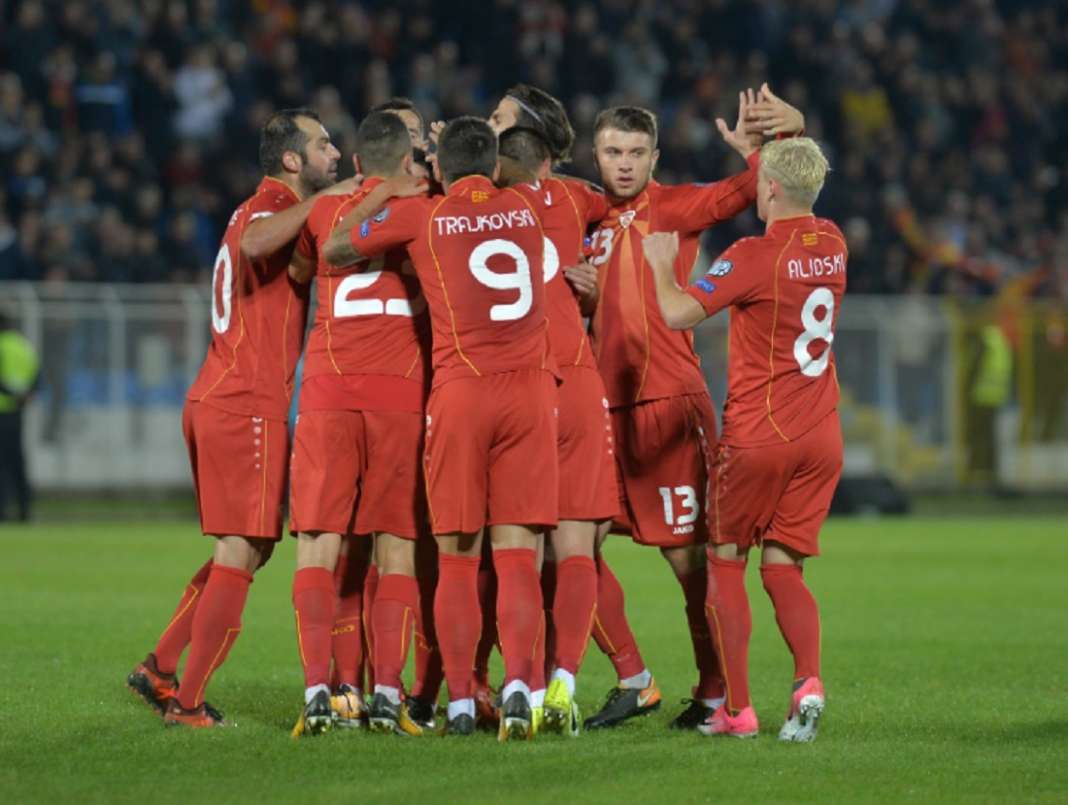
Macedonia is preparing for a major World Cup playoff semifinal against Denmark in Copenhagen, with the match scheduled for March 26, 2026, at 20:45 at Parken Stadium. The fixture is being treated as one of the national team’s most important matches of the current cycle, not only because of the strength of the opponent, but also because the winner will move on to the playoff final against the winner of the other semifinal between Ireland and the Czech Republic.
The match is therefore being framed as a direct gateway to the next and decisive stage in the race for a place at the 2026 World Cup. The atmosphere around the game is being described as especially intense, with Macedonia heading into a high-pressure away environment and a stadium expected to be filled almost entirely by home supporters.
Parken sold out as Macedonia prepares for a hostile away atmosphere
One of the main themes in the pre-match coverage is the setting in which Macedonia will have to perform. Danish football authorities have confirmed that Parken is sold out, meaning that around 37,000 home fans are expected to create a strong backing for Denmark. Reports describe the venue as a difficult and heated environment, one that will test North Macedonia’s composure and competitive maturity.
At the same time, Macedonia will not be without support in the stands. Around 1,000 tickets have been allocated for Macedonian supporters, and those fans are expected to form a visible and vocal away section. The contrast, however, remains stark: a small but organized Macedonian presence against a full stadium overwhelmingly behind the hosts.
Travel and fan organization in Copenhagen
Extensive organizational details have also been issued for Macedonian fans traveling to the match. A dedicated fan zone has been arranged at The Old Irish Pub, which will open from 12:00 on match day. Organized movement toward the stadium is set to begin around 18:30, with part of the trip taking place by free train and part on foot, under coordination with local police.
Stadium gates will open at 19:15. Macedonian supporters will be placed in sector D1, while holders of first-category tickets will be seated in sector A9. Entry to other sectors will not be allowed. Fans have been told that once they enter the stadium, they will not be permitted to leave and re-enter, and that they must carry a valid identification document, either an identity card or passport, and present it if requested by officials.
No tickets will be sold on the day of the match, while parking around the stadium is limited, paid, and available on a first-come, first-served basis. Supporters have also been informed of strict stadium rules regarding items that may be brought inside. Flags and banners are allowed only up to 1m by 1.5m, and all flags containing text must receive prior approval. Cameras, food and drinks are not permitted, while bags and backpacks are allowed only up to A4 size. Pyrotechnics, fireworks, smoke bombs and other dangerous objects are strictly prohibited. Additional items such as drums and megaphones require a formal prior request, including photographs of the items and contact information for the carrier.
Denmark dealing with major defensive and goalkeeping problems
Although Denmark enters the match as the favorite on paper and benefits from home advantage, the pre-match reports emphasize that the hosts are also facing serious personnel problems, particularly in central defense and in goal. Denmark is expected to be without its three best central defenders: Andreas Christensen, Joachim Andersen, and Jannik Vestergaard. Christensen is reported to be out for the rest of the season, Andersen is unavailable, and Vestergaard is still considered too fragile for a match of this intensity after groin surgery a month ago.
As a result, coach Brian Riemer is expected to improvise in the heart of defense. According to the reports, the likely central defensive pairing against North Macedonia will consist of Oliver Provstgaard of Lazio, who would make his debut, and Christian Nørgaard of Arsenal, a midfielder who would be used out of position as a center-back. Nørgaard has reportedly already been forced into that role on three occasions for Arsenal, in the FA Cup, League Cup and Premier League.
Denmark’s problems are not limited to defense. In goal, the likely starter is expected to be Mads Hermansen, described in the reports as effectively the coach’s third-choice goalkeeper. Regular first-choice keeper Kasper Schmeichel is seriously injured and is expected to undergo shoulder surgery, while second goalkeeper Filip Jørgensen is also unavailable due to injury. The reports further note that midfielder Mikkel Damsgaard, an important player in Denmark’s midfield, is also injured, although the medical staff is said to be making maximum efforts to have him ready for the playoff against North Macedonia.
An unusual backdrop: Denmark voting as Macedonia arrives
An additional and unusual layer to the build-up is the domestic political context in Denmark. Reports note that on the very day North Macedonia travels to Copenhagen, Denmark is holding regular parliamentary elections, making national politics the central focus of public attention two days before the playoff. According to the same reports, the Macedonian team’s charter flight is scheduled for 15:00, and the squad is expected to arrive in the Danish capital around the time polling stations close.
This detail has been highlighted as an unusual coincidence: while Denmark’s public debate is dominated by the formation of a new government and the choice of a new prime minister for the next three years, Macedonia’s national team is landing in Copenhagen to prepare for one of the most important football matches of its recent period.
A match of pressure, opportunity and belief
Taken together, the pre-match coverage presents a game defined by three parallel elements: the size of the opportunity for North Macedonia, the pressure of the setting, and the vulnerabilities on the Danish side. North Macedonia will play in a sold-out stadium before roughly 37,000 home supporters, with only about 1,000 Macedonian fans inside the venue, yet it will do so against a Denmark team weakened by injuries in some of its most important defensive positions.
That combination gives the playoff a clear narrative. Denmark remains the nominal favorite, especially at home, but Macedonia approaches a match in which the margin for error is minimal and the reward is substantial: survival in the playoff race and a place in the final step toward the World Cup. The organization around the game, the full stadium, the travel plans for supporters, and the injury problems facing the hosts all point to a contest that is being treated as one of the defining football nights of Macedonia’s current campaign.