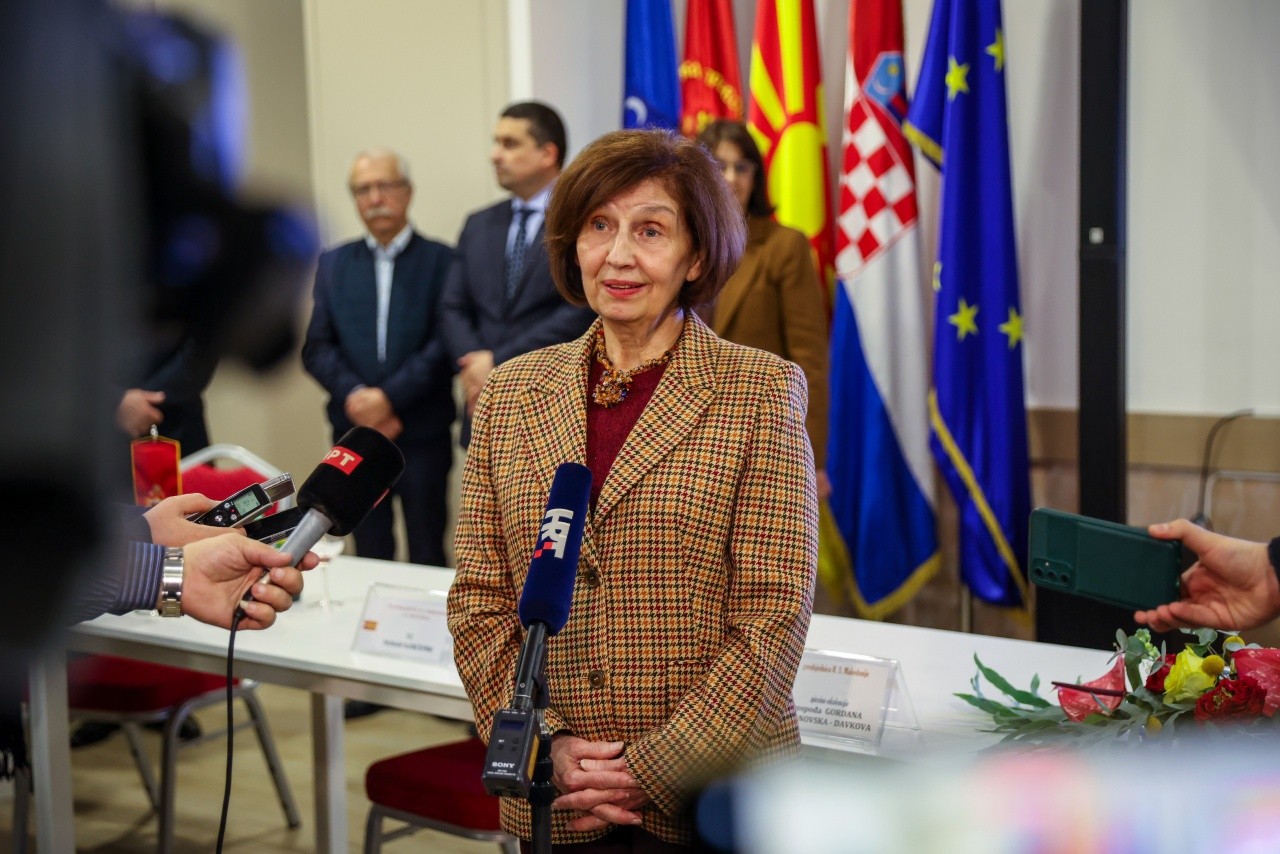
During President Gordana Siljanovska-Davkova’s official visit to Croatia, Croatian President Zoran Milanović said Macedonia is being asked to meet too many conditions in its long-running path toward the European Union. He stressed that the country itself must decide what is best for it and which path it wants to follow, presenting that choice as one tied to prosperity, peace and stability for its citizens.
Milanović also used broader language about the meaning of EU membership, saying that the European Union is an “upgrade” but “not the building itself” and that the real substance of a country lies in its own internal foundations, traditions, and society. In the same context, he said there is life outside the EU and that such a life can also be successful and dignified.
Siljanovska-Davkova points to a stalled accession process and double standards
Siljanovska-Davkova agreed with the assessment that Macedonia’s candidate status has lasted too long. She said the country had committed itself to the European path, received around twenty or more positive reports, yet negotiations still had not effectively taken place. She also said that Macedonia is being asked to do “the strangest things,” including changing its Constitution.
According to the reporting, she emphasized that Skopje seeks the lifting of double standards and wants progress to be evaluated under the same criteria applied to other countries. Another account tied this directly to the wider reality of Macedonia’s EU process, noting that although the country obtained candidate status in 2005 and changed its name to resolve the dispute with Greece, its European path remains slowed by bilateral disputes, especially Bulgaria’s veto.
The visit to Zagreb also focused on the Macedonian community
As part of the official program in Croatia, Siljanovska-Davkova visited the Macedonian Orthodox Church “St. Zlata Meglenska” in Zagreb, where she met representatives of the Macedonian community. She said she felt “at home” in the church and described it as an important center for preserving the identity, culture, and tradition of Macedonians in the diaspora.
She also thanked the Croatian authorities and citizens for the support and understanding that enabled the Macedonian community to have its own spiritual home. During the visit, she underlined that Croatian–Macedonian relations are an example of successful cooperation and recalled the long historical connection between the two countries, from cultural to academic ties.
Symbolism of the church visit and messages from the diaspora meeting
At the church, Siljanovska-Davkova was welcomed by Father Kirko Velinski, who presented her with an order as a sign of respect and gratitude for the visit. He said the church is not only a place of prayer but also a spiritual and cultural center linking Macedonians with their homeland. In his words, it is a place where faith, tradition, customs, language, and identity are nurtured and a bridge between the homeland and the diaspora.
The meeting with representatives of the Macedonian community included an exchange of views on their position in Croatia and on possibilities for strengthening ties with North Macedonia. The talks were described as taking place in a warm atmosphere, with a clear focus on preserving national identity, language, and culture.
A visit combining regional friendship with European frustration
Taken together, the visit brought out two parallel messages. On one side, it highlighted the closeness of Croatian–Macedonian relations and the importance of the Macedonian community in Croatia as a living bridge between the two countries. On the other hand, it became a platform for open criticism of the length and conditions of North Macedonia’s EU accession process, with both presidents pointing to the weight of the demands placed on Skopje and the prolonged nature of its candidate status.