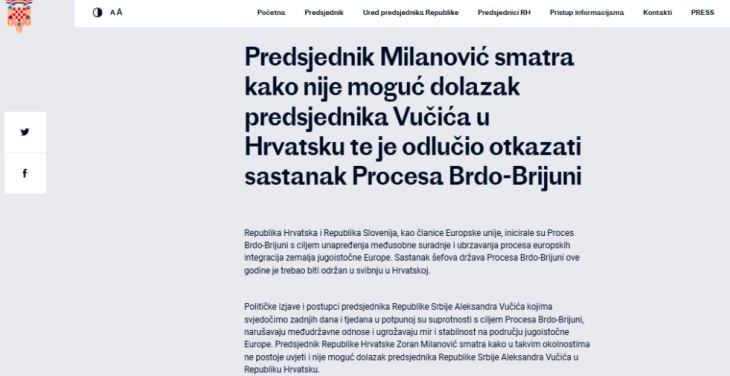
Croatian President Zoran Milanović announced that he was cancelling this year’s Brdo-Brijuni Process summit in Croatia, saying that under the current circumstances, there were no conditions for Serbian President Aleksandar Vučić to come to the country. In his statement, Milanović said Vučić’s recent political statements and actions were contrary to the purpose of the Brdo-Brijuni Process, damaged interstate relations, and endangered peace and stability in Southeast Europe. The meeting had been planned for May in Croatia, with the Brijuni Islands as the host site.
The immediate trigger was the latest escalation between Zagreb and Belgrade
The dispute escalated after Vučić accused a neighbouring state, understood in the coverage as Croatia, of providing logistical support during local elections in Serbia. The reporting also said that he spoke about informing Vladimir Putin about what he described as an alliance of Zagreb, Pristina, and Tirana. Another point of tension mentioned in the coverage was the Croatian ban on the entry of historian Miloš Ković, which Vučić called “barbarism” or “savagery,” further worsening the atmosphere between the two countries. In that environment, the summit was presented as politically untenable by Milanović’s side.
Slovenia says the initiative may continue elsewhere
Although Milanović cancelled the summit in Croatia, the process itself may not be halted. The office of Slovenian President Nataša Pirc Musar, who co-chairs the initiative together with Milanović, said it had been informed in a timely and proper manner about Croatia’s intention. Slovenia also said it would not interfere in what it described as an internal political decision of the Croatian president. At the same time, it confirmed that contacts between the two offices were continuing and that there was an intention for the Brdo-Brijuni summit to still be held this year, but at an alternative location.
What the Brdo-Brijuni Process represents
The reports stress that the Brdo-Brijuni Process was launched by Croatia and Slovenia in 2010 to strengthen cooperation and accelerate the European integration of Southeast European countries. It is co-chaired by the presidents of Croatia and Slovenia, and includes, besides those two states, Serbia, Albania, Bosnia and Herzegovina, Montenegro, North Macedonia, and Kosovo. Annual meetings are one of its central mechanisms, which is why the Croatian cancellation immediately raised questions about the wider regional impact of the move.
Criticism from diplomatic circles
The coverage also included criticism of Milanović’s decision from former Croatian ambassador to Russia Božo Kovačević. He called the cancellation a bad move that narrowed the already limited space for dialogue in the region. Kovačević argued that even if the summit itself does not produce binding decisions, every such meeting creates room for exchange of views and at least some level of understanding among regional leaders. He also said Milanović had not isolated only Vučić but, to a degree, himself as well and described the decision as political exhibitionism.
Public reaction in Croatia was sharply supportive of the cancellation
One of the articles focused on reactions on social media, especially on Reddit, where the dominant tone was strongly supportive of Milanović’s decision. According to that report, many users argued that cooperation with Vučić’s government had brought no concrete results over many years and described further attempts at engagement as a complete waste of time. The same coverage also noted criticism of the European Union from commenters who believed Brussels had been too lenient toward Vučić. That public mood was presented as part of a broader frustration over the current state of Croatian-Serbian relations.
A regional summit has now turned into a political test
Taken together, the reports portray the Brdo-Brijuni summit as having shifted from a regular regional gathering into a symbol of the current breakdown in relations between Croatia and Serbia. Milanović’s move was framed as a direct response to Vučić’s recent rhetoric and conduct, while Slovenia’s reaction suggested that the initiative itself should survive even if Croatia no longer hosts this year’s meeting. The coverage also shows that the decision has opened a wider debate: whether isolating Vučić is a justified political signal or whether cancelling a regional forum only further reduces opportunities for dialogue at a moment of already heightened tensions in Southeast Europe.