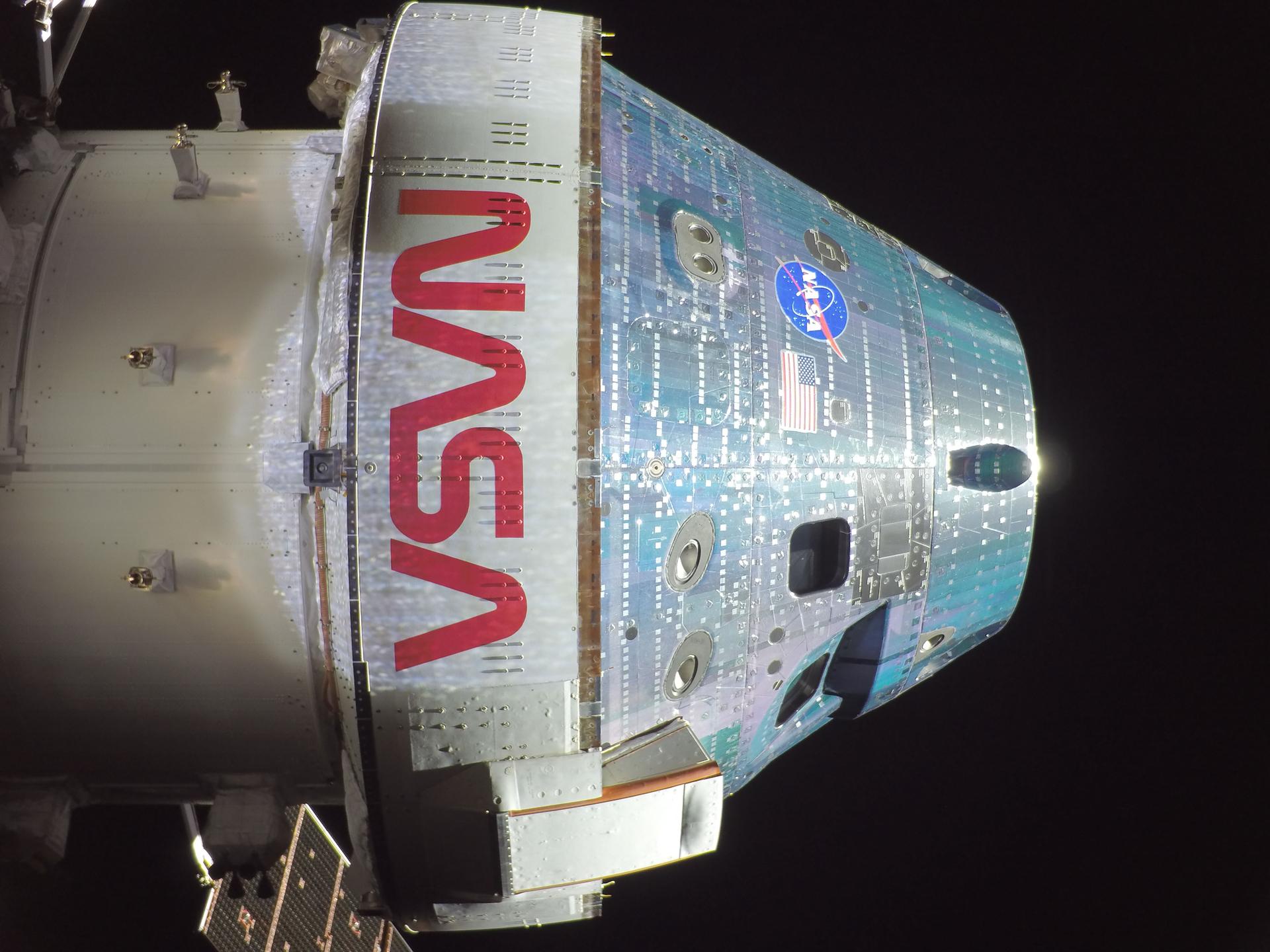
NASA’s Artemis II mission has entered the history books after the four-member crew aboard the Orion spacecraft traveled farther from Earth than any humans before them, surpassing the distance record set by Apollo 13 in 1970. NASA said the crew passed the previous record at 248,655 miles from Earth and later reached the mission’s maximum distance of 252,756 miles, establishing a new milestone in human spaceflight. The mission, launched on April 1, is the first crewed Artemis flight and is designed as an approximately 10-day journey around the Moon and back to Earth.
Orion’s lunar flyby marks the closest human approach in more than 50 years
The Artemis II crew carried out a flyby around the far side of the Moon, bringing humans closer to the lunar surface than at any point in more than half a century. During the closest approach, Orion flew about 4,067 miles above the Moon’s surface before continuing its path home. NASA described the mission as the first crewed lunar flyby of the Artemis era and a critical test of the systems that will support future human exploration deeper into space.
A mission built as a full-scale rehearsal for what comes next
The flight is being treated as a complex dress rehearsal for future lunar surface missions. Artemis II is testing the Orion spacecraft, crew operations, and deep-space mission procedures in the environment beyond Earth orbit, while also laying the groundwork for later missions aimed at returning astronauts to the Moon and eventually supporting missions toward Mars. One of the reports described the mission not simply as a technological demonstration, but as a broader test of endurance, planning, and human persistence.
The crew observed the Moon’s far side and entered a planned blackout period
As Orion passed behind the Moon, communication with Earth was interrupted for about 40 minutes during the planned loss-of-signal phase of the mission. From that trajectory, the astronauts were able to observe the Moon’s far side, a view unavailable from Earth, while NASA also prepared scientific observation targets for the crew to examine during the flyby. According to NASA, the mission team aimed to use the crew’s direct observations to gather useful visual data on the lunar surface and its characteristics under varying angles and lighting conditions.
“Earthset,” eclipse viewing, and moments that turned the mission into a spectacle
The coverage emphasized several of the mission’s most striking visual moments. Among them was the view known as “Earthset,” in which Earth appeared to sink behind the lunar horizon, followed later by the visual return of Earth into view. The reports also said the crew witnessed a total solar eclipse from their perspective near the Moon, with the Moon fully covering the Sun for nearly an hour from that vantage point. Together, these moments added a rare visual and emotional dimension to a mission already defined by technical and historical significance.
A personal gesture added an emotional layer to the historic flight
Beyond the technical achievements, the reporting also highlighted a deeply personal moment connected to mission commander Reid Wiseman. During the mission, the crew was given a symbolic opportunity tied to visible lunar craters, and one crater was dedicated in honor of Wiseman’s late wife, Carol. Another report noted that Canadian astronaut Jeremy Hansen proposed that one crater be named after her, prompting an emotional reaction from Wiseman and the rest of the crew. That moment turned part of the mission into a personal tribute as well as a scientific and operational milestone.
The crew and mission profile underline the scale of Artemis II
The crew of Artemis II consists of NASA astronauts Reid Wiseman, Victor Glover, and Christina Koch, along with Canadian Space Agency astronaut Jeremy Hansen. NASA has presented the mission as the first crewed test flight of the Space Launch System rocket and Orion spacecraft under the Artemis program. As the spacecraft continues its return leg toward Earth, the mission stands as a defining step in NASA’s renewed push toward sustained lunar exploration.
A symbolic success for a new era of exploration
Taken together, the reports present Artemis II as more than a successful flight around the Moon. It is being framed as proof that human deep-space exploration has decisively re-entered a new phase, with the crew breaking long-standing records, completing a lunar flyby, conducting observations of the far side of the Moon, and returning with a mission profile intended to pave the way for what follows. In that sense, Artemis II is being portrayed not as the endpoint of a journey but as the beginning of a broader new chapter in human space exploration.