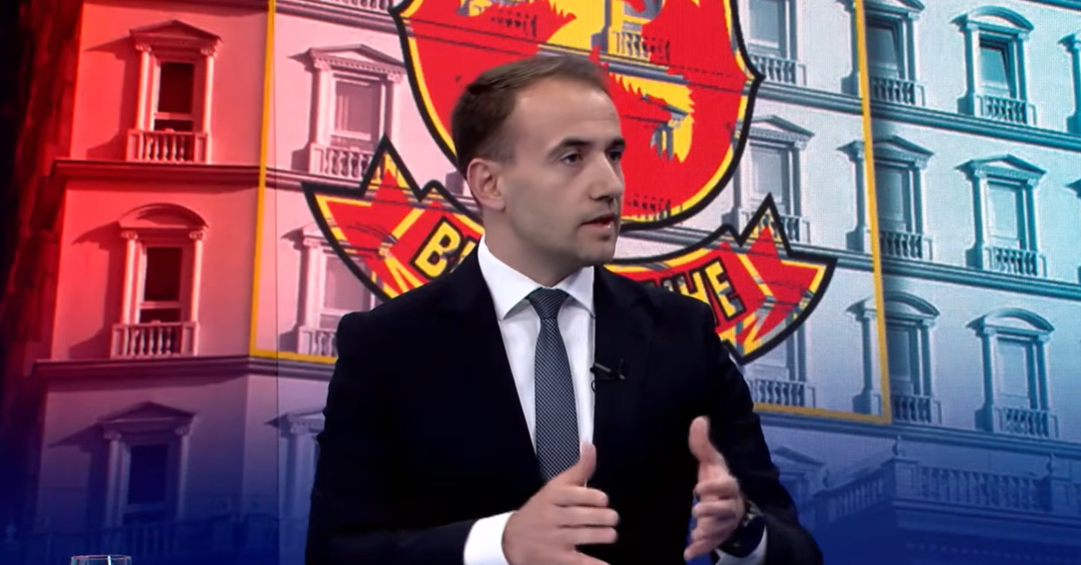
Macedonia’s ruling VMRO-DPMNE parliamentary group has submitted draft amendments to the Law on Members of Parliament that would introduce an additional eligibility condition: a person could serve as an MP only if they hold Macedonian citizenship and no other citizenship. The proposal was formally filed in parliament on April 21 and was presented by VMRO-DPMNE MP Bojan Stojanoski as a direct legislative initiative aimed at changing the criteria for parliamentary office. According to the reports, the proposal is expected to be placed before the plenary session, and the party is seeking support beyond its own ranks for the measure to move forward.
The immediate political trigger for the proposal, according to the ruling party’s representatives, was a statement issued by SDSM that raised the question of whether some MPs had voted in the elections in neighboring Bulgaria. Stojanoski said the move came as a response to what he described as renewed accusations and speculation about dual citizenship among public officials, especially claims involving alleged Bulgarian citizenship. He denied that he or the other MPs mentioned in those accusations hold any citizenship other than Macedonian, and he challenged political opponents to make such claims publicly and directly rather than, as he put it, from the parliamentary rostrum. In the reports, he framed the initiative as both a political answer and a legal instrument meant to settle the issue through formal rules rather than public insinuation.
The proposal was also publicly defended by VMRO-DPMNE MP Dafina Stojanoska, who said the amendments would put an end to what she described as a “soap bubble” created around lists and allegations that certain officials hold dual citizenship. She stressed that some of the signatories to the draft law are precisely MPs whom SDSM had accused of possessing Bulgarian citizenship, arguing that it would be absurd for them to sign such a proposal if the accusations were true. She called on SDSM MPs to declare themselves clearly once the proposal comes to a vote, saying the parliamentary debate would show who genuinely supports such a solution and who is bluffing on the issue of dual citizenship. In that sense, the initiative is being presented not only as a legal proposal, but also as a political challenge to the opposition.
One of the most significant details in the submitted coverage is that VMRO-DPMNE says the proposed legal solution should not apply only to future candidates. Asked whether the change would take effect only from the next elections or would also concern the present parliamentary composition, Stojanoski said the proposal is intended to apply to the current parliament as well. He also said the motive was to clear up the issue immediately and repeated the broader political argument behind the draft: that someone deciding on the most important acts of the state should be a citizen of only one country. That detail gives the proposal a more immediate political weight, because it suggests the initiative is not being framed merely as a future electoral standard, but as a rule with present institutional implications.
The reports say the draft has been submitted under a shortened procedure. VMRO-DPMNE representatives expressed confidence that the proposal can secure enough support to continue through the parliamentary system, although they also noted that under the current Rules of Procedure it can still become the subject of amendments. Stojanoski recalled that a text he described as identical had been submitted five years ago but was not supported at the time by the then-ruling SDSM-DUI majority. In the current context, he said it remains to be seen how the parties will position themselves when the law is discussed in parliament, while also expressing the belief that the draft in its present legal form can obtain the necessary backing to proceed further.
Although the submitted draft specifically concerns MPs, the coverage also indicates that the governing party may see this as a first step rather than a final limit. Stojanoski said that later there could be discussions about extending similar rules to other office-holders as well, while emphasizing that any such legal solutions would have to remain in line with the Constitution. That point suggests that the initiative, as currently presented, is narrowly focused on parliamentary office, but is being politically discussed within a potentially broader debate about whether high state officials should be required to hold only Macedonian citizenship.
Taken together, the reports present the proposal as a politically charged legal initiative emerging from a dispute over alleged dual citizenship and alleged voting in Bulgaria. VMRO-DPMNE is framing the move as a way to end speculation, impose a clear standard for parliamentary office, and force rivals to take a public position. At the same time, by insisting that the proposal should also apply to the current parliamentary composition and by placing it under expedited procedure, the ruling party has turned the issue into an immediate political confrontation rather than a distant institutional debate. The central message of the initiative, as described in the reports, is that only citizens with exclusively Macedonian citizenship should be allowed to sit in the country’s parliament.