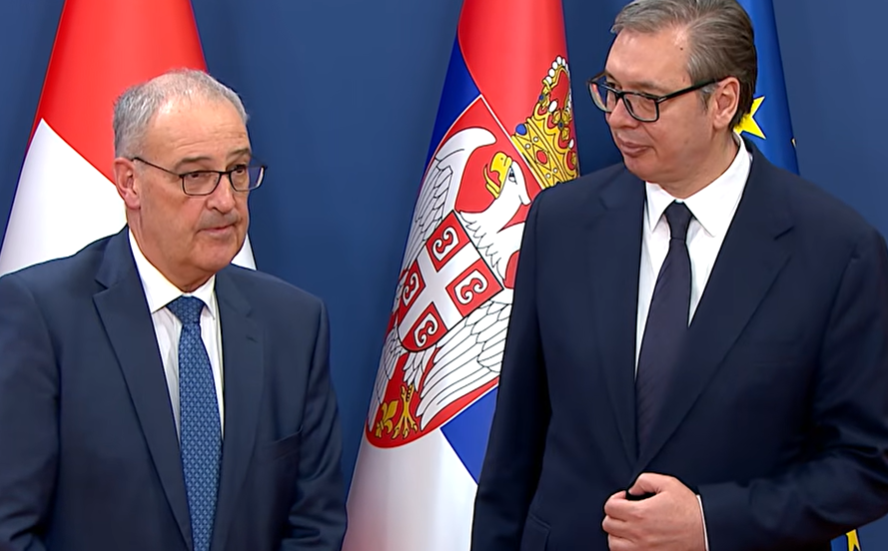
Serbia and Switzerland are looking to deepen their cooperation in trade, innovation, education and democratic development, following a meeting in Belgrade between Serbian President Aleksandar Vučić and Swiss President Guy Parmelin.
The visit carries symbolic weight, as it marks 110 years since the establishment of diplomatic relations between the two countries and represents the first visit by a Swiss president to Serbia in 18 years.
Speaking after the meeting, Vučić said bilateral relations had strengthened significantly over the past decade, particularly in trade and services. According to him, trade between Serbia and Switzerland has increased fourfold over the last 12 years, while the exchange of services has grown almost tenfold.
He said trade in services now stands at around 1.62 billion euros, while overall trade exchange is approximately 1.1 billion euros. Switzerland, he added, remains one of Serbia’s most important investors, with investments estimated at around three billion euros.
Vučić also highlighted the role of the Serbian community in Switzerland, saying that around 130,000 Serbs living across Swiss cantons represent an important bridge between the two countries.
A major part of the talks focused on innovation and new technologies. The two sides signed a cooperation program in the field of innovation, with Vučić saying Serbia hopes to learn from Switzerland’s experience in high technology, artificial intelligence and modern business development.
“I believe both sides can benefit greatly from this cooperation,” Vučić said, adding that Serbia has a large number of young and talented people, particularly in the technology and services sectors.
Another key topic was dual education, a model Switzerland is widely known for. Vučić said Serbia had previously made strong progress in introducing the Swiss approach, but admitted that resistance had grown within parts of the education system and government.
He said the model requires closer involvement from private companies and difficult reforms, but argued that it could significantly improve Serbia’s economy and workforce readiness if fully implemented.
Swiss President Guy Parmelin said Switzerland remains ready to support Serbia in developing dual education further. He invited a Serbian delegation to visit Switzerland and see how the model works in factories, research institutions and other sectors.
Parmelin described himself as a product of the Swiss vocational education system and said its success shows how practical training can create strong career opportunities.
The Swiss president also welcomed the newly signed innovation agreement, saying it should help encourage partnerships, speed up the commercialization of products and services, and strengthen cooperation between companies from both countries. He noted that legal certainty, predictability, fair competition and transparent public procurement are essential conditions for attracting investment.
The two leaders also discussed a cooperation program for the period 2026–2029. Switzerland is expected to allocate 93 million euros for different areas of cooperation with Serbia, including democratic institutions, sustainable urban development, environmental issues and social inclusion.
Parmelin also proposed launching a bilateral dialogue on human rights between Switzerland and Serbia. He said Switzerland already conducts similar dialogues with several countries and sees them as a way to discuss sensitive issues openly and constructively.
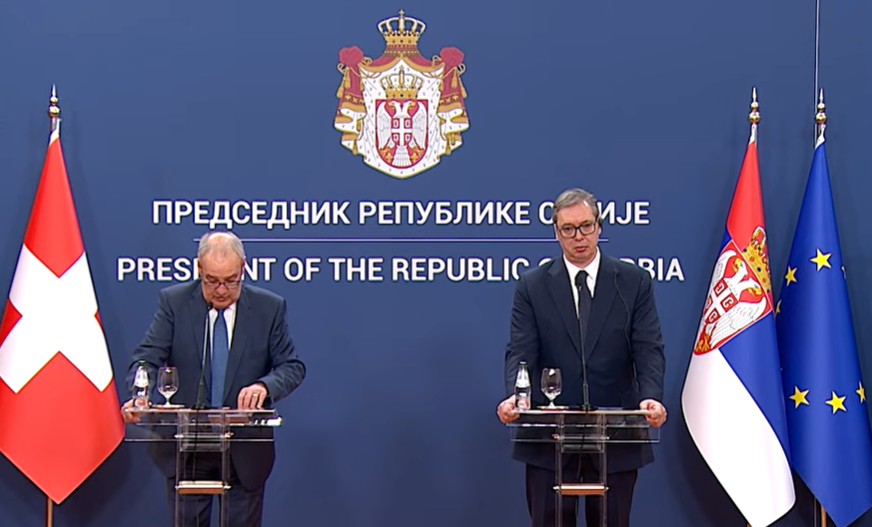

Vučić said Serbia is prepared to take part in such discussions, provided they are conducted professionally and impartially, and focused on improving the position of different social, political and minority groups.
Regional stability was also part of the agenda. Parmelin said Switzerland considers KFOR important for security in Kosovo and noted that 215 Swiss soldiers are currently deployed as part of the Swisscoy mission. He added that the Swiss parliament will soon decide whether to extend the mission until 2029.
On relations between Belgrade and Pristina, Parmelin said dialogue, normalization and practical progress remain the only sustainable path forward. Switzerland, he said, is ready to support informal mediation efforts that could help build trust and contribute to stability in the region.
Vučić, meanwhile, said the international situation is becoming increasingly complicated, but repeated that Serbia’s priority remains peace, stability and the protection of its national and economic interests. He also reaffirmed that Serbia remains on the European path and said he expects new legal reforms related to the judiciary and electoral process to soon enter parliamentary procedure.
The meeting in Belgrade was presented by both sides as an opportunity to strengthen long-term cooperation, especially in areas where Switzerland has strong experience and Serbia sees room for growth: innovation, investment, vocational education, institutional development and regional dialogue.