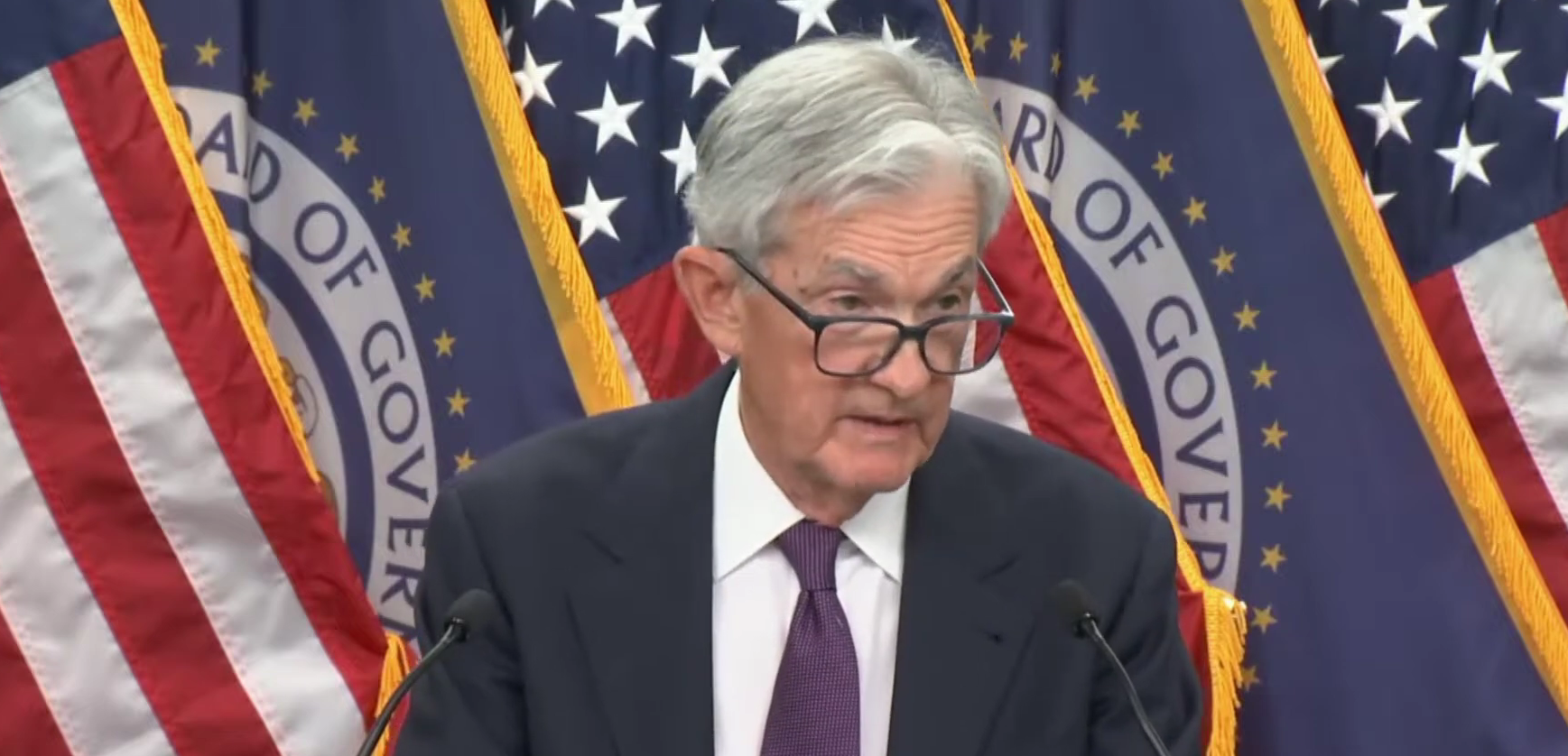
The Federal Reserve held interest rates steady at 3.5-3.75% on Wednesday, marking Jerome Powell’s final meeting as chair before his term ends on May 15, while revealing deep internal divisions over whether the central bank should prepare to cut rates or remain neutral amid the economic chaos triggered by the US Iran war.
Powell confirmed he will step aside as chair but remain on the Fed’s board through January 2028, making him the first departing chair to stay on since 1948, and he used his farewell press conference to highlight the “vigorous” debate among policymakers about the path forward. The decision to hold rates was nearly unanimous, with only Governor Stephen Miran disagreeing in favor of cuts for the sixth straight meeting, but three regional Fed presidents, Beth Hammack of Cleveland, Neel Kashkari of Minneapolis, and Lorie Logan of Dallas, explicitly opposed including any “easing bias” in the official statement, signaling that a significant bloc of the 12 person committee sees no case for lower borrowing costs anytime soon.
The economic backdrop makes their caution understandable. Energy prices remain elevated due to the Iran war and the effective closure of the Strait of Hormuz, Americans continue spending despite inflation fears, and the labor market, while weak, appears to have stabilized rather than deteriorating. The Fed’s own policy statement acknowledged that “developments in the Middle East are contributing to a high level of uncertainty about the economic outlook,” leaving officials in a holding pattern where neither rate hikes nor cuts seem immediately justified. Powell noted that some committee members wanted the statement to communicate a “neutral stance, so that a hike is as likely as a cut,” reflecting the genuine confusion about whether the economy is overheating or slowing. This marks the first time since October 1992 that four dissents of any kind have been recorded, underscoring how fractured the agreement has become.
Powell’s successor, Kevin Warsh, Trump’s nominee who cleared the Senate Banking Committee on Wednesday and is expected to favor additional rate cuts, will inherit a committee that may resist his preferred path. While Warsh could theoretically push for easier monetary policy, Powell’s experience demonstrates that the chair controls only one vote in a consensus driven body where “nineteen strong minded people” must be persuaded. Powell also revealed that his decision to remain on the board stems partly from an ongoing Justice Department investigation led by DC US Attorney Jeanine Pirro into testimony he gave Congress about the Fed headquarters renovation, stating he will leave “when I think it’s appropriate to do so” after the probe concludes with “finality and transparency.” For markets and the broader economy, the takeaway is clear: the Fed is paralyzed by uncertainty, the Iran war has destroyed any predictable path for interest rates, and the incoming chair will face a committee more divided than at any point in three decades.