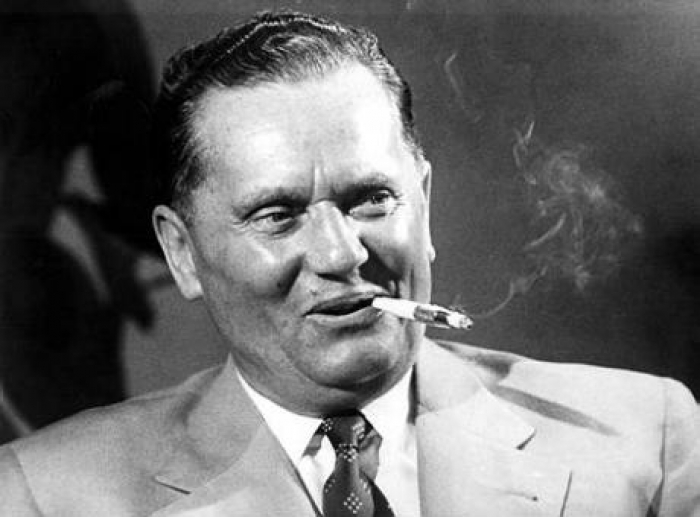
May 4 marks 46 years since the death of Josip Broz Tito, one of the most influential political figures of the 20th century and the longtime president of socialist Yugoslavia.
Tito died in 1980 at the age of 87 after a prolonged illness. His death was announced with the now-famous words: “Comrade Tito has died,” a sentence that immediately echoed across the country and signaled the end of an era. The reaction was unprecedented—factories stopped, public life paused, and millions of citizens mourned collectively.
A Funeral That Stunned the World
Tito’s funeral, held in Belgrade, became one of the largest state funerals ever recorded. Delegations from over 100 countries attended, including world leaders, monarchs, and representatives from both sides of the Cold War divide.
This global turnout reflected Tito’s unique geopolitical position. As a founding figure of the Non-Aligned Movement, he maintained independence from both the Soviet Union and the United States, giving Yugoslavia a rare level of international influence for a country of its size.
Power, Control, and a Carefully Built Image
Tito ruled Yugoslavia for more than three decades, creating a federal state that united multiple ethnic groups under a single political system. During his leadership, the country experienced relative stability, economic growth, and a distinctive socialist model that allowed more openness compared to Eastern Bloc nations.
However, his rule was also marked by strict political control. Opposition was suppressed, and dissent was often not tolerated—especially in the early years following World War II.
At the same time, Tito cultivated a powerful personal image. He was known for his luxurious lifestyle, elegant white uniforms, and strong presence on the global stage, frequently hosting world leaders and celebrities.
The Story of a Building He Couldn’t Stand
Among the lesser-known anecdotes about Tito is his strong dislike for a prominent building in Belgrade—the Beograđanka (Belgrade Palace).
According to accounts, Tito was not fond of its modernist design and believed it did not fit the visual identity of the city at the time. Despite his influence, the building was completed and went on to become one of Belgrade’s most recognizable landmarks—highlighting that even Tito’s authority had limits when it came to architectural and urban decisions.
After Tito: The Beginning of the End
Tito’s death created a political vacuum in Yugoslavia. Without his unifying authority, the country began to experience increasing internal tensions among its republics.
Although a collective presidency was introduced to maintain balance, it proved unable to hold the federation together in the long term. Over the following decade, economic struggles and rising nationalism contributed to the eventual breakup of Yugoslavia in the early 1990s.
A Legacy Still Debated
More than four decades later, Tito remains a deeply polarizing figure.
For some, he represents a period of unity, stability, and international respect. For others, he symbolizes an authoritarian system that suppressed freedoms and delayed underlying conflicts.
What is undeniable is his historical impact. Tito managed to lead a complex, multi-ethnic state for decades and positioned it as a significant player on the global stage, something few leaders from the region have achieved before or since.
Today, the anniversary of his death continues to draw attention across the Balkans, serving as a reminder of a leader whose influence transcended borders and whose legacy still shapes how the region understands its past.