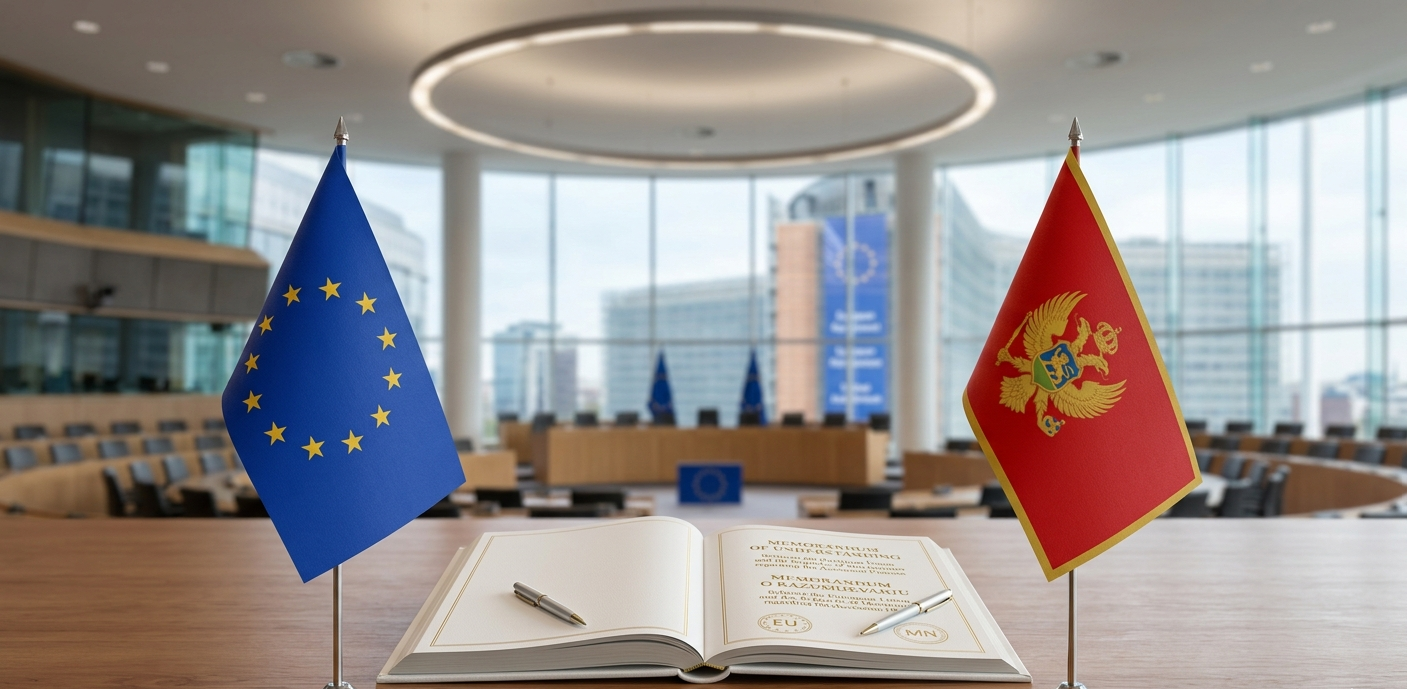
The European Union has officially launched the technical drafting of Montenegro’s Accession Treaty, marking a watershed moment in the bloc’s first real enlargement push in over a decade. On 13 May 2026, the Cyprus Presidency of the Council of the EU convened the inaugural meeting of the Ad Hoc Working Group tasked with preparing the legal framework for Podgorica’s membership, just weeks after EU ambassadors endorsed the body’s creation on 22 April. The Cyprus Presidency described the step as sending “a strong and positive message that enlargement remains a credible and forward looking priority,” underscoring that the European future of the Western Balkans is advancing steadily. European Council President António Costa hailed the move as a “key milestone,” noting it was the first time since 2013 that Brussels had “started the clock” for a new member’s entry.
The launch of the working group places Montenegro firmly in the final stretch of a journey that began when it applied for membership in December 2008, gained candidate status in 2010, and opened accession negotiations in June 2012. After nearly fourteen years of talks, Podgorica has emerged as the undisputed frontrunner among the six candidates currently in active negotiations, having provisionally closed fourteen of its thirty three negotiating chapters, including the critical rule of law chapters 23 and 24 that had long stalled progress. The remaining nineteen chapters, covering areas from judiciary and fundamental rights to environment, agriculture, and external relations, are now the focus of an accelerated timeline that sees Montenegro aiming to wrap up all technical negotiations by the end of 2026. European Enlargement Commissioner Marta Kos has called this goal “ambitious but doable,” while Prime Minister Milojko Spajić has framed the treaty drafting as confirmation that his country is entering the final phase of integration. The political significance extends beyond Montenegro itself, the process is expected to serve as a blueprint for what Kos has termed a “new generation” of accession treaties, incorporating stronger post entry safeguards against democratic backsliding and rule of law erosion, lessons drawn from earlier enlargement rounds that proved difficult to reverse once new members were inside the bloc.
Yet the path to a 2028 membership target remains strewn with obstacles that could yet delay or complicate the timeline. Veteran EU integration observer Gordana Đurović, a former Montenegrin deputy prime minister for European affairs, has cautioned that while closing all chapters in 2026 is technically feasible, the real test lies in demonstrating a stable track record on rule of law implementation, particularly in high level corruption and organized crime cases, judicial independence, and media freedom. The EU’s insistence on tangible results rather than merely adopted legislation means Podgorica must sustain reforms through what is expected to be a politically volatile period ahead of national elections in summer 2027. Bilateral tensions with neighboring Croatia, concerns over foreign influence in domestic politics, and the need for cross party parliamentary cooperation add further layers of complexity. Internally, the EU is not immune to its own political headwinds, the European Conservative notes that far right movements across the continent are weaponizing enlargement’s potential impact on the EU budget and institutional capacity, while the parallel fast tracking of Ukraine and Moldova has created a perceived hierarchy of candidates that risks eroding reform incentives in the Western Balkans. Still, the geostrategic imperative of anchoring the region firmly within the European fold, especially against the backdrop of Russian influence, continues to provide powerful momentum. For now, the opening of the Ad Hoc Working Group signals that after years of stalled promises, Montenegro’s EU accession has moved from diplomatic aspiration to technical reality.