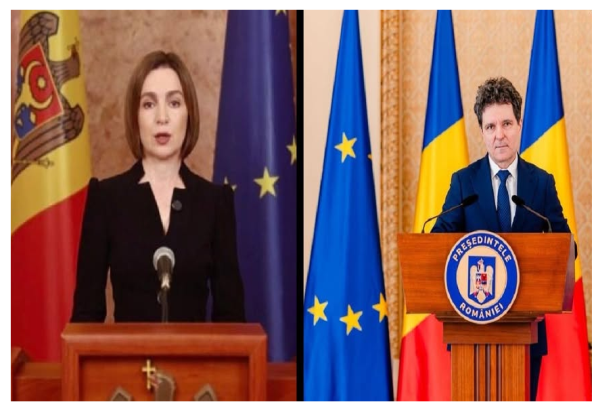
The idea of possible unification between Romania and the Republic of Moldova has returned to public debate, no longer only as a historical or symbolic question, but as an issue shaped by European integration, regional security, Russian influence and the unresolved status of Transnistria. For the first time, both countries are led by presidents who view the idea positively: Moldova’s Maia Sandu and Romania’s Nicușor Dan.
Sandu has approached the issue cautiously, but in recent interviews she has spoken more openly about it. In January 2026, she said that if a referendum on unification were held, she would personally vote in favour. She later repeated a similar position in an interview with Le Monde. Romanian President Nicușor Dan has also expressed support, saying that “Romania is ready” for such a project.
The debate is rooted in deep linguistic, cultural and historical ties. Romanian is the official language in both countries, while Moldova and Romania share a complex history connected to the former Principality of Moldavia, the 1918 union with Romania, Soviet annexation in 1940 and Moldova’s independence in 1991.
Public opinion remains divided. A March 2026 poll showed that around 42 percent of Moldovans support unification, while 47 percent oppose it. In Romania, support is much higher, at around 72 percent. The war in Ukraine, Moldova’s security concerns and its reduced dependence on Russian energy have contributed to the renewed intensity of the debate.
However, major obstacles remain. Both countries face constitutional and political challenges, while Moldova’s declared military neutrality adds another layer of complexity. The biggest unresolved question is Transnistria, a region still controlled by pro-Russian separatists.
The European Union has not presented the issue as a taboo, but has avoided giving political encouragement for a rapid process. EU foreign policy chief Kaja Kallas said that any decision on possible unification could be made only by the citizens of Moldova and Romania, and by no one else.
For now, unification is not an immediate political decision, but the fact that it is again being seriously discussed shows how much Moldova’s strategic position has changed. In the shadow of the war in Ukraine, European integration and Russian pressure, the question is increasingly framed not only as a matter of history, but also as one of security, identity and the future of a small state in a changing Europe.