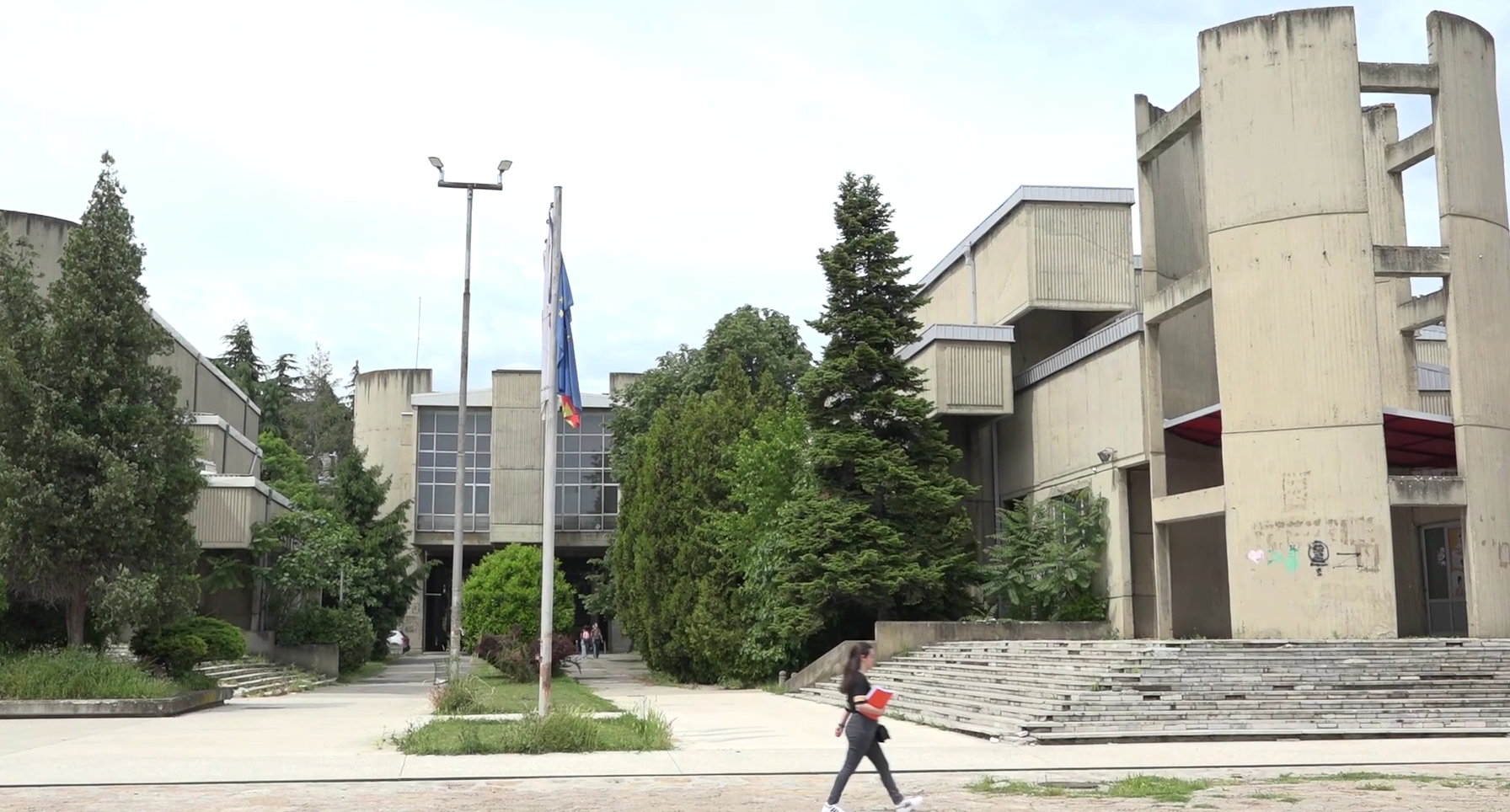
The University of Ss. Cyril and Methodius in Skopje is holding its annual patron saint day ceremony on 23 May, commemorating the 77th anniversary of its founding and the legacy of the two Byzantine brothers who created the Glagolitic alphabet and are celebrated across the Slavic world as the apostles of literacy. The festivities on the university’s main campus began with the laying of flowers at the monument to the saints, followed by an address from Rector Prof. Dr. Biljana Angelova in the ceremonial hall. The event also serves as a moment of academic recognition, with awards presented to the highest achieving graduates of the 2024/2025 academic year and the conferral of the “26 July” prize funded by the Frank Manning Foundation, underscoring UKIM’s role as both a custodian of national heritage and a hub for cultivating the next generation of Macedonian scholars.
Founded on 24 April 1949 as the first state university in what was then the Socialist Republic of Macedonia, UKIM has grown from an institution of three faculties and 58 students into the country’s largest and oldest center of higher learning, now encompassing 23 faculties, five research institutes, and over 60,000 students across all three cycles of study. Its origins trace back further to 1920, when the Faculty of Philosophy was established in Skopje as an outpost of the University of Belgrade, and to the post war revival of 1946, when the Macedonian communist authorities laid the cornerstone of a genuinely national university. The 1963 Skopje earthquake, which levelled much of the city, also destroyed some of the most modern laboratories in Yugoslavia, the university was swiftly rebuilt on a larger urban campus with international aid channeled through UNESCO, a resilience that remains part of its institutional DNA. Today, UKIM ranks as a leading research university in the Western Balkans, with more than 150,000 alumni, 3,100 academic and administrative staff, and active participation in European programs such as Erasmus and the European University Association.
Beyond the formal speeches and awards, the 77th anniversary program includes an artistic performance and a tour of the “Wall of Creative Alphabet,” a graphic map exhibition that reimagines the Cyrillic script as a living cultural artefact. The choice of 24 May as the patron day is itself deeply symbolic across the region, in Macedonia it anchors the university’s identity to a narrative of Slavic enlightenment and cultural continuity. For students and faculty gathering on the Skopje campus, the ceremony is less a political statement than an affirmation of a centuries old mission, transmitting knowledge through an alphabet that once carried Christianity to the Slavs and now carries young Macedonians into an integrated European academic space. As the university looks toward its eighth decade, the challenge is to balance that venerable heritage with the demands of modernization, internationalization, and the brain drain pressures that have seen many of its brightest graduates seek careers abroad.