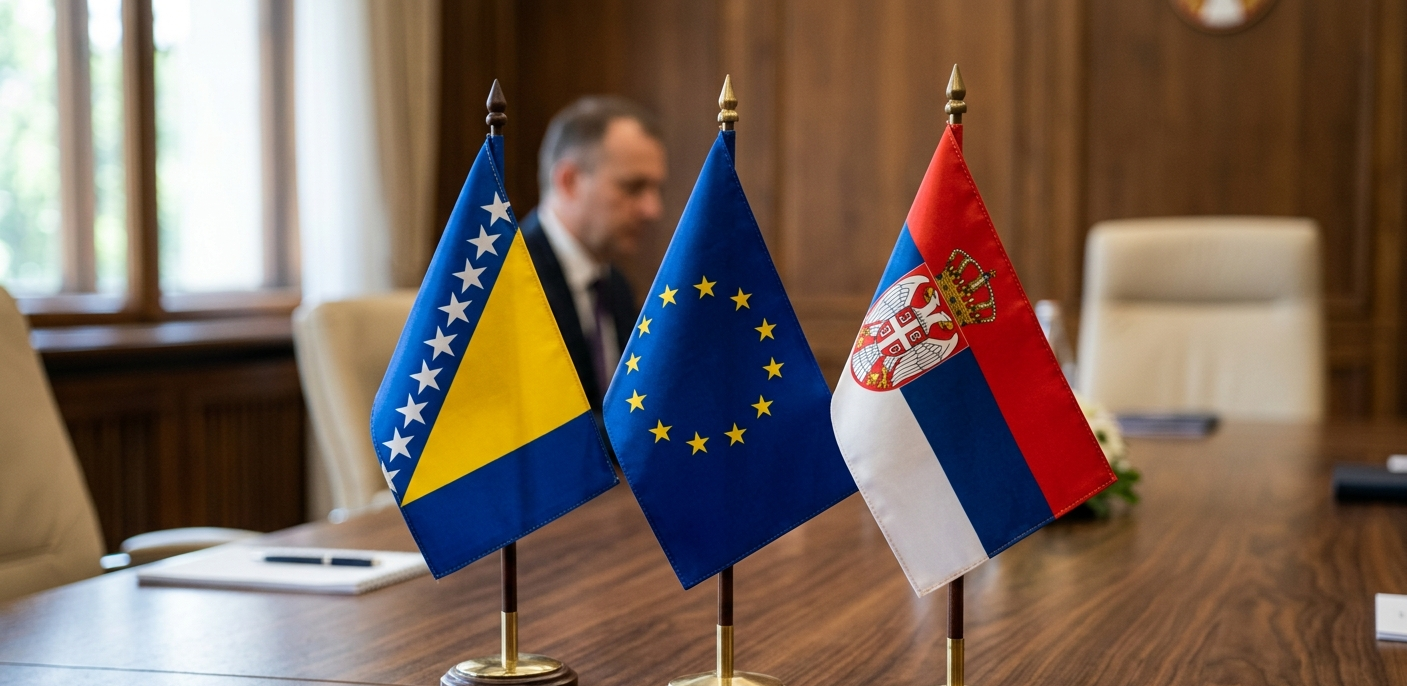
The European Parliament’s Committee on Foreign Affairs has adopted sharply critical reports on Serbia and Bosnia and Herzegovina, with rapporteur Tonino Picula declaring that Serbia’s EU accession path “will remain blocked” until its political leadership demonstrates genuine commitment to European values rather than merely declaring them. The reports, approved on 3 June and scheduled for a full plenary vote, paint a grim picture of democratic regression, foreign interference, and institutional capture across the Western Balkans. For Serbia, the document condemns the “Serbian World” concept as incompatible with EU membership, accuses senior officials of spreading conspiracy theories about EU involvement in domestic protests, and warns that Belgrade’s deepening security ties with China and Russia are destabilizing the entire region.
The Serbia report, drafted by Croatian MEP Tonino Picula, pulls no punches. It states that Serbia “cannot credibly claim EU membership is a strategic goal while continuously undermining democratic standards, ignoring key reforms and recommendations on electoral integrity, and failing to align with the EU’s foreign and security policy.” The text condemns President Aleksandar Vučić’s “aggressive and provocative rhetoric” against neighbors, noting his unsubstantiated claims that Croatia, Albania, and Kosovo are preparing to attack Serbia, a narrative used to justify the recent purchase of Chinese CM-400AKG supersonic missiles. The report sharply criticizes the continued operation of the Russian-Serbian Humanitarian Centre in Niš, described as functioning as a GRU intelligence base, and demands an immediate end to all military cooperation with Moscow. It also rejects Serbian officials’ accusations that the EU orchestrated the November 2024 student protests, condemns the harassment and deportation of EU citizens who expressed solidarity with demonstrators, and dismisses claims that Croatia interfered in local elections in March 2026. On minority rights, the Parliament demands equal treatment for the Croatian minority in Serbia matching that of Serbs in Croatia, and deplores the appropriation of Croatian cultural heritage and the questioning of the Croatian language’s status.
The Bosnia and Herzegovina report, presented by Czech MEP Ondřej Kolář, expresses regret over the resignation of High Representative Christian Schmidt and insists that any successor must come from an EU member state with a clear mandate to gradually close the Office of the High Representative and transfer responsibilities to an EU Special Representative. The text warns that political divisions, secessionist threats from Republika Srpska leader Milorad Dodik, and the “captured state” phenomenon continue to undermine public trust and drive emigration. It calls for urgent constitutional and electoral reforms to ensure all citizens can exercise political rights equally, and demands adherence to the European Convention on Human Rights and implementation of rulings from Bosnia’s Constitutional Court and the European Court of Human Rights. A Green Party amendment ensures that any electoral reform must not deepen ethnic divisions. Both reports express grave concern over malicious disinformation and foreign interference from Russia, Serbia, Turkey, Iran, and Gulf states, aimed at sowing discord, violence, and inter ethnic tensions. China’s growing economic and political influence through strategic infrastructure and lending is singled out as a particular threat to regional stability.
The parliamentary scrutiny arrives at a delicate moment for both countries. Serbia has seen eighteen months of continuous anti government protests triggered by the Novi Sad railway station collapse, yet Vučić’s grip on parliament, the judiciary, and the media remains near total according to the latest Freedom House assessment. The European Commission’s Reform and Growth Facility has already disbursed €76 million to Belgrade, with another tranche pending, but Picula questions whether such stagnation and regression are compatible with continued EU funding. Bosnia, for its part, received EU candidate status in 2024 conditional on reforms that have yet to materialize, while Dodik’s secessionist rhetoric and the paralysis of state level institutions leave the country dependent on the Office of the High Representative and the EUFOR military presence. The reports make clear that Brussels is losing patience with the stability over reform approach that has long characterized its Balkan policy. Whether this sharper tone translates into concrete consequences, such as frozen funds or suspended negotiations, will depend on the plenary vote and the political will of member states, many of which have historically preferred manageable autocrats to unpredictable democracies in their southeastern neighborhood.