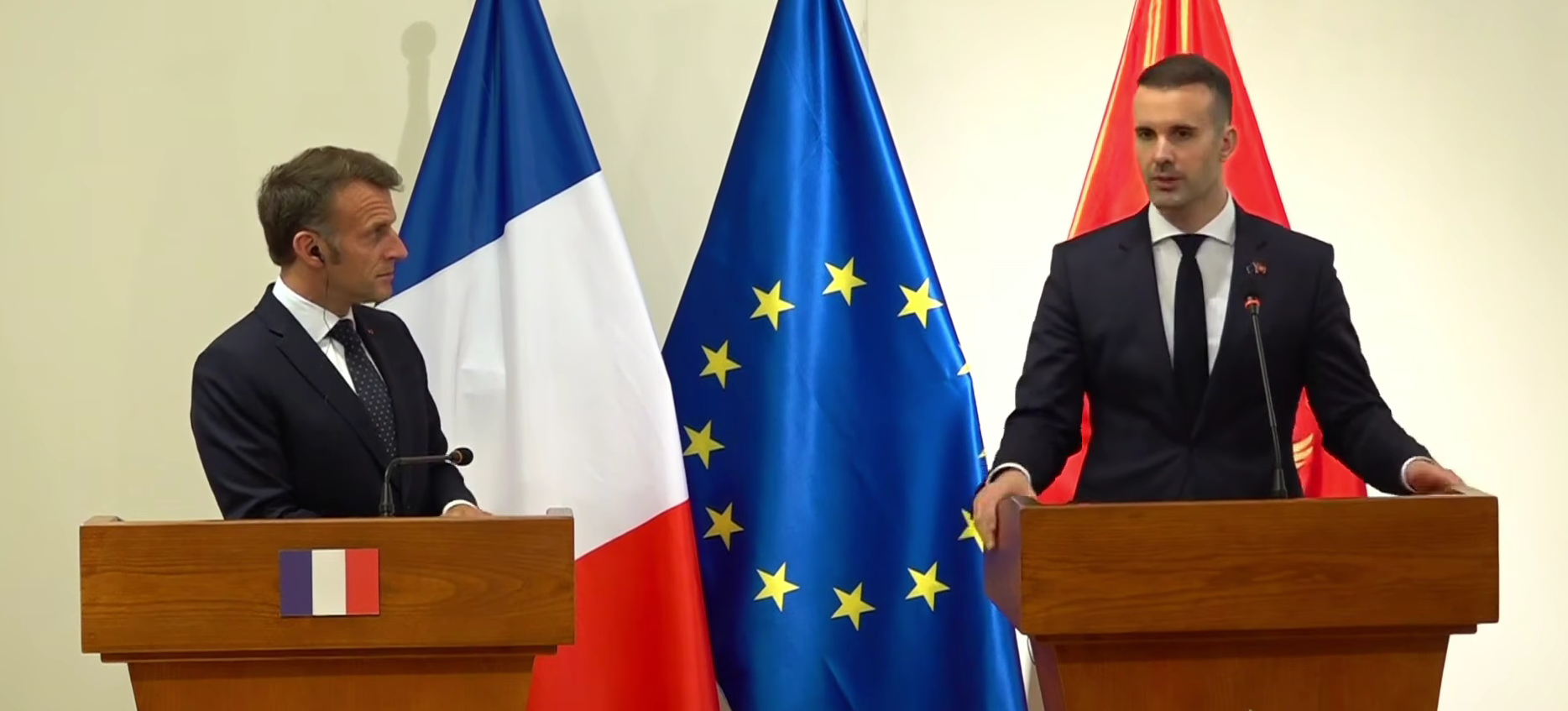
French President Emmanuel Macron and Montenegrin Prime Minister Milojko Spajić oversaw the signing of several agreements and memorandums in Podgorica on 5 June, cementing a rapidly deepening partnership between the two countries across healthcare, infrastructure, energy, and EU enlargement advocacy. The most significant contract is a €313 million deal with Bouygues Bâtiment International to design and build a new University Clinical Center of Montenegro in Podgorica, a 60,000 square meter facility with more than 700 beds, 19 operating theatres, and state of the art diagnostic equipment including multiple MRI machines and four CT scanners, expected for completion by 2031. The project, funded through French financial instruments including export credits and loans from the French Ministry of Finance, represents one of the largest healthcare infrastructure initiatives in Montenegro’s history.
The signing ceremony also produced agreements on the A2-2 section of the Adriatic-Ionian Highway between Monteput and Bouygues Travaux Publics, a non binding credit line between the French Development Agency and Montenegro, and a tripartite partnership between Montenegro’s electricity distributor CEDIS, the AFD, and EDF International. Macron used the occasion to deliver a strong message of support for Montenegro’s EU accession, declaring that Western Balkan countries have a “natural place in the EU” and praising Podgorica for taking that path “responsibly and decisively in recent years.” Spajić noted that when he and Macron first met in 2024, there was little French corporate interest in Montenegro, the agreement signed last year, he said, had “triggered an avalanche of interest,” with contracts for helicopters soon to follow and cooperation expanding into areas “we could not even imagine a year ago.”
For Montenegro, the French partnership arrives at a pivotal moment. The country is in the final stretch of EU accession negotiations, with 14 of 33 chapters provisionally closed and an ad hoc working group established in April to draft the Accession Treaty. Macron’s visit, his second to the region in recent months, reinforces France’s role as a key advocate for enlargement at a time when Brussels is trying to demonstrate that the Western Balkans remain central to its strategic vision. The healthcare deal also addresses a critical domestic need, the current Clinical Centre of Montenegro is the country’s sole tertiary care institution, serving the entire population, and the new facility will significantly expand capacity for specialist treatment, medical education, and research. Whether the Bouygues project stays on schedule and within budget will test Montenegro’s capacity to manage large scale international contracts, but for now, the symbolism of a French president standing beside a Montenegrin prime minister declaring EU membership inevitable sends a powerful signal to both Brussels and the region.