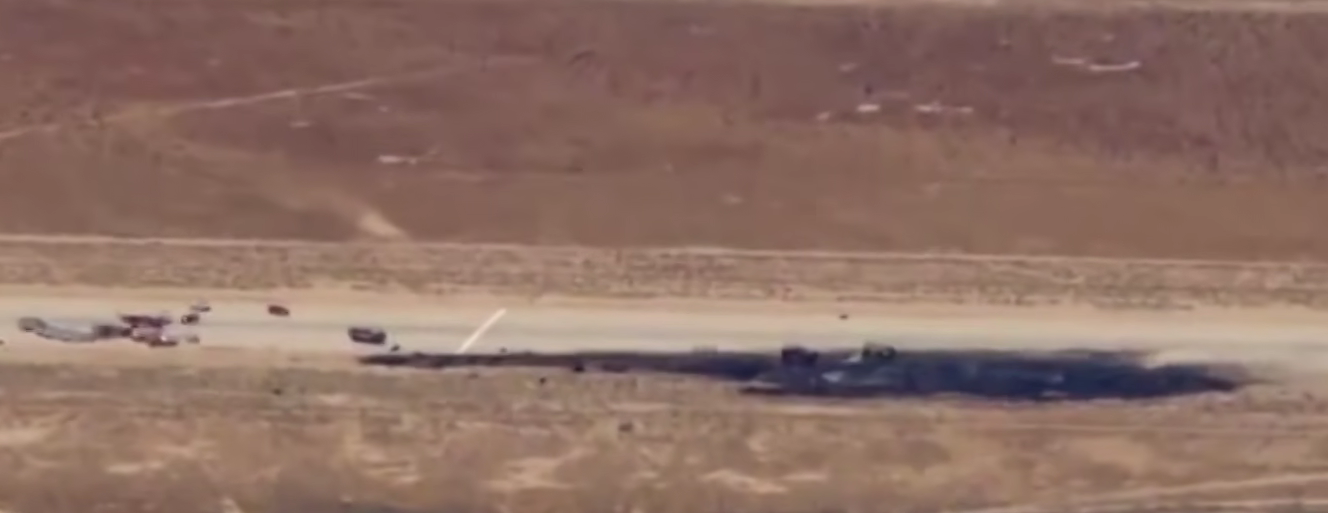
A B-52 Stratofortress crashed shortly after takeoff on Monday from Edwards Air Force Base in Southern California, killing all eight crew members aboard in the deadliest accident involving the iconic bomber since 1982. The aircraft, which departed at 11:20 a.m. on a routine test mission supporting the fleet’s modernization program, went down in the desert about 100 miles northeast of Los Angeles. The Air Force released the names of the victims Wednesday after notifying their families, revealing a crew that blended active duty military personnel with civilian contractors, reflecting the increasingly common practice of combining government and private sector expertise in flight testing.
The victims included five active duty Air Force officers and three civilian contractors. Colonel Gregory Watson, 53, of Shreveport, Louisiana, was a Boeing employee and Air Force reservist serving as a weapons systems officer. Lieutenant Colonel Gabriel Estrella, 40, was an active duty weapons systems officer with the Air Force Operational Test and Evaluation Center at Edwards. Retired Lieutenant Colonel Miles Middleton, 50, of Tehachapi, California, had transitioned to a pilot role with Boeing after his military service. Major Alexander Davis, 34, Major Robert Dee, 40, and Major Brad Hovey, 35, were all pilots with the 419th Flight Test Squadron. Christopher Rischar, 41, was a flight test engineer with defense contractor JT4, and Jeromy Smith, 32, was a flight test engineer with the 419th Flight Test Squadron. The crash marks the first fatal B-52 accident since 2008, when six personnel died after their bomber went down off Guam, and the deadliest since nine crew members were killed in a training accident at Mather Air Force Base near Sacramento in 1982.
The human toll extends far beyond the flight line. Jeromy Smith had just celebrated his fourth wedding anniversary with his wife Lauren days before the crash, the couple was raising two sons, ages two and four months. “He’s a hero. He is someone that people look up to, and just an all around amazing person,” said Lauren Smith. “He died doing what he loved.” Christopher Rischar, who had worked at Edwards for a decade alongside his father, was teaching his 15 year old daughter to drive and had just marked his 17th wedding anniversary with wife Rebecca in April. Brianna Estrella, wife of Lieutenant Colonel Gabriel Estrella, wrote on Facebook that her husband of three children “woke up everyday excited to go to work” and had told her before the flight, “It’s a once in a lifetime flight, babe.” Colonel Thomas Tauer, commander of the 412th Test Wing, addressed workers and families at the base, saying, “These Airmen were more than coworkers. They were friends, mentors, teammates and valued members of our Edwards and Air Force family.” Boeing issued a statement mourning the loss of Watson and Middleton, noting that “our hearts remain with their families, loved ones and those who worked with them.”
The crash comes at a sensitive moment for the B-52 program, which is undergoing extensive modernization to extend its service life into the 2050s. The aircraft involved was supporting the Radar Modernization Program, which replaces the bomber’s aging mechanically scanned radar with a new active electronically scanned array system. A B-52 equipped with the upgraded radar had completed its ferry flight to Edwards in December 2025, and the test program was scheduled to run through 2026. The B-52J variant, projected to enter service around 2033, is also slated to receive new Rolls Royce F130 engines. The accident raises inevitable questions about the safety of pushing the 70 year old airframe through another generation of upgrades, even as the Air Force insists the bomber remains essential to long range strike capability. An investigation into the cause of the crash is underway, though officials have not released preliminary findings. For now, the focus at Edwards remains on honoring the fallen and supporting the grieving families left behind.