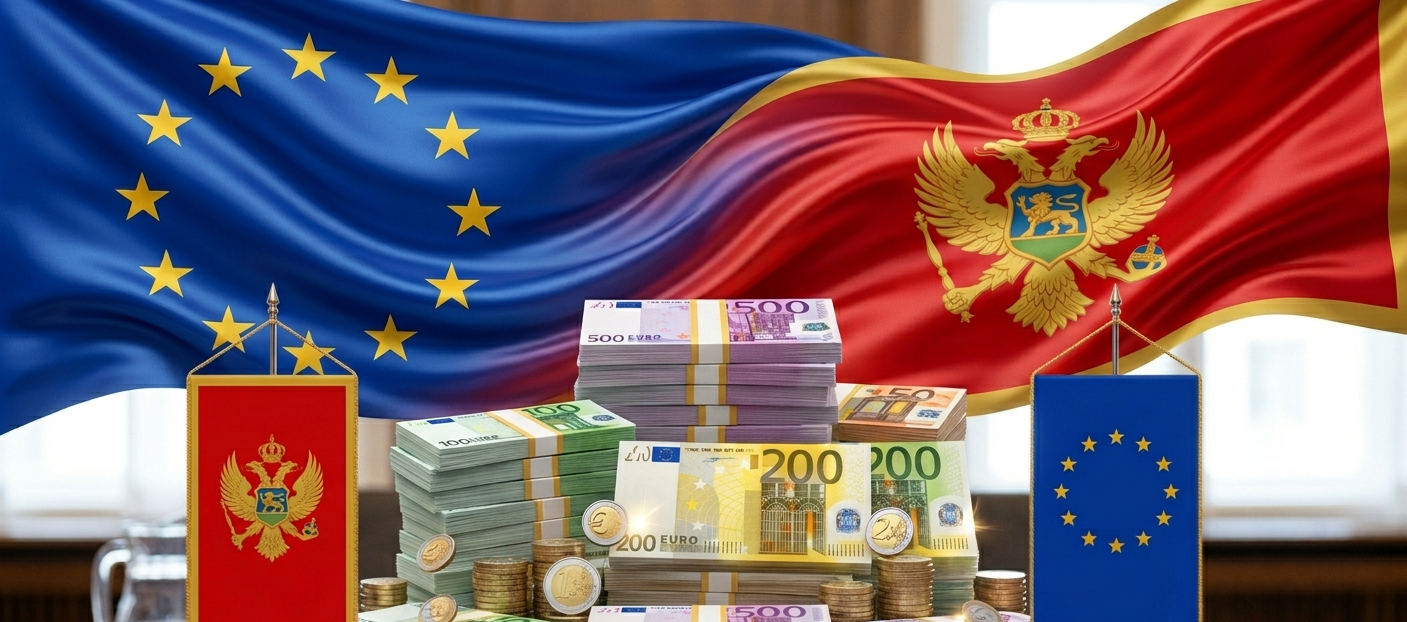
The European Commission has adopted a €3.2 billion financial package for Montenegro, a clear signal that Brussels views Podgorica’s EU membership not as a distant possibility but as a near certainty to be budgeted for. The package, which covers the 2028-2034 Multiannual Financial Framework period, reveals a striking asymmetry, Montenegro’s estimated contribution to the EU common budget is approximately €500 million over seven years, meaning the country will receive more than six times what it pays in. As one Commission official colorfully told Politico, the cost to European taxpayers amounts to “one euro per EU citizen per year”, “a very cheap cup of coffee.”
The package is designed with flexibility in mind. If Montenegro misses the 2028 target and accedes a year or two later, it will continue receiving pre accession assistance rather than full membership funds, though the total amount would likely be reduced due to less time to spend it. The Commission emphasized that the package is “conditional on Montenegro maintaining progress in the negotiations” and “does not prejudge the provisional closure of any chapter.” A key innovation is the transfer of pre accession funds to support internal EU policies, reducing costs for existing member states while ensuring continuity for Montenegro. The allocations are calibrated to what the country can realistically absorb, between 5% and 6% of its estimated €8 billion GDP annually, with phased increases for agricultural subsidies reflecting the gradual ramp up typical of new members.
The breakdown reveals where the money will flow. Over the full cycle, Montenegro is earmarked to receive €277 million for farmer subsidies, over €1 billion for regional payments and rural development, €592 million from migration funds, and €523 million from the European Competitiveness Fund for domestic companies. Analysts note that new member states typically struggle to spend their full allocations in the first years as they build administrative capacity. Christoph Bender of the European Stability Initiative estimates Montenegro’s annual contribution at roughly €75 million, while Strahinja Subotić of the Belgrade based Center for European Policy calls the package proof that Montenegro’s EU path is now “one of no return” if ratification by member states succeeds. “There is indeed a political consensus right now that Montenegro should be the first next member,” Subotić said. “The Commission would not have done this if it simply didn’t feel the time was right.”
For Montenegro, the challenge now is execution. With 16 of 33 chapters provisionally closed and the government targeting full closure by year’s end, the €3.2 billion figure provides both incentive and pressure. The Commission’s package covers scenarios where Montenegro enters the MFF as either a candidate or a member state, ensuring no administrative gap. Yet the money comes with strings, continued progress in negotiations, maintenance of reform momentum, and successful ratification of the accession treaty by all EU members. The package also serves a strategic purpose for Brussels, demonstrating that enlargement remains credible and affordable even as the EU grapples with Ukraine’s candidacy and internal budget pressures. For a country whose per capita cost to the EU is minimal, the potential return, economic development, institutional strengthening, and a foothold in the Western Balkans, is substantial. Whether Montenegro can absorb €457 million annually and transform it into tangible improvements for its citizens will determine whether this “cheap cup of coffee” becomes the investment that cements its European future.