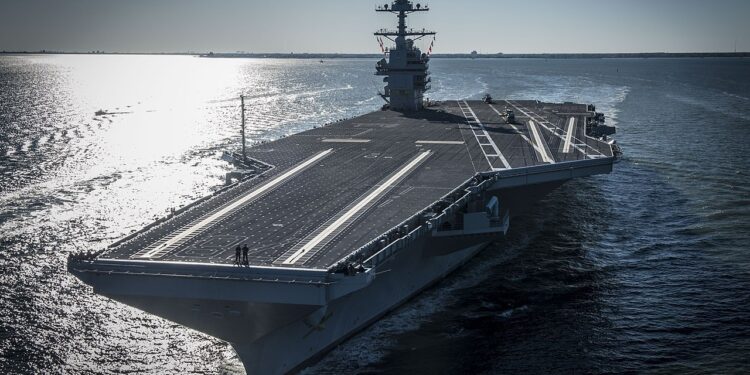
The USS Gerald R. Ford, described in the coverage as the largest aircraft carrier in the world, has left the Croatian port of Split after a five-day stay during which repairs, maintenance work, and resupply were carried out, and the vessel is now ready to continue its mission. According to the reports, the U.S. Navy said the carrier had completed the necessary technical work in Split and was prepared to resume operations, a development that was widely interpreted as a sign that it could rejoin American military forces already deployed in the wider Middle East. At the same time, one of the reports noted that the ship’s exact new route after departing Split was not officially disclosed, even though the broader context of its deployment was linked to operations connected to the conflict involving Iran.
The carrier had arrived in Split on March 28 after being temporarily withdrawn following a fire that broke out on March 12 in the laundry area while the ship was operating in the Red Sea. The coverage says three sailors were injured in the incident and that the fire also affected part of the crew’s accommodation area. In the statements cited after the ship departs from Croatia, the Navy confirmed that the repairs had been completed and that the vessel had also been supplied with what was needed to continue its mission. The reports add that the investigation into the cause of the fire is still ongoing.
The stay in Split was presented not only as a technical stop, but also as a brief operational pause during an active and wider U.S. military deployment. One of the reports says that members of the crew used their free time in Croatia’s second-largest city, while during the visit, Rear Admiral Paul Lanzilotta, commander of Carrier Strike Group 12, met with U.S. Ambassador to Croatia Nicole McGraw for talks described as focusing on the strike group’s current engagement and continued mission readiness. These details were used in the reporting to underline that the stop in Split was part of a larger strategic deployment rather than an isolated port visit.
The broader military context featured prominently in all three reports. They state that the Gerald R. Ford and its escort group had been sent toward the Middle East in mid-February to join other American naval forces already operating near the Iranian coast, thereby strengthening the U.S. military presence in the region. The coverage further says that this reinforced presence came several weeks before the start of joint U.S.-Israeli attacks mentioned in the reports, and that carriers in the area, including the USS Abraham Lincoln, serve as platforms for dozens of aircraft and thousands of troops involved in the air campaign against Tehran.
Additional reporting also stated that a third aircraft carrier, the USS George H. W. Bush, was sailing toward the Middle East accompanied by three destroyers and a strike group of more than 6,000 sailors, which was presented as further evidence of a significant American naval buildup in the region. The Ford strike group, according to the Navy details cited in the reports, has been at sea since June 2025 and has already conducted operations in the Arctic Circle, the Mediterranean, the Caribbean, and the Red Sea. Taken together, the reports portray the carrier’s departure from Split as the end of a short but important technical stop and the beginning of its return to a much larger and increasingly tense operational theatre connected to the confrontation with Iran.