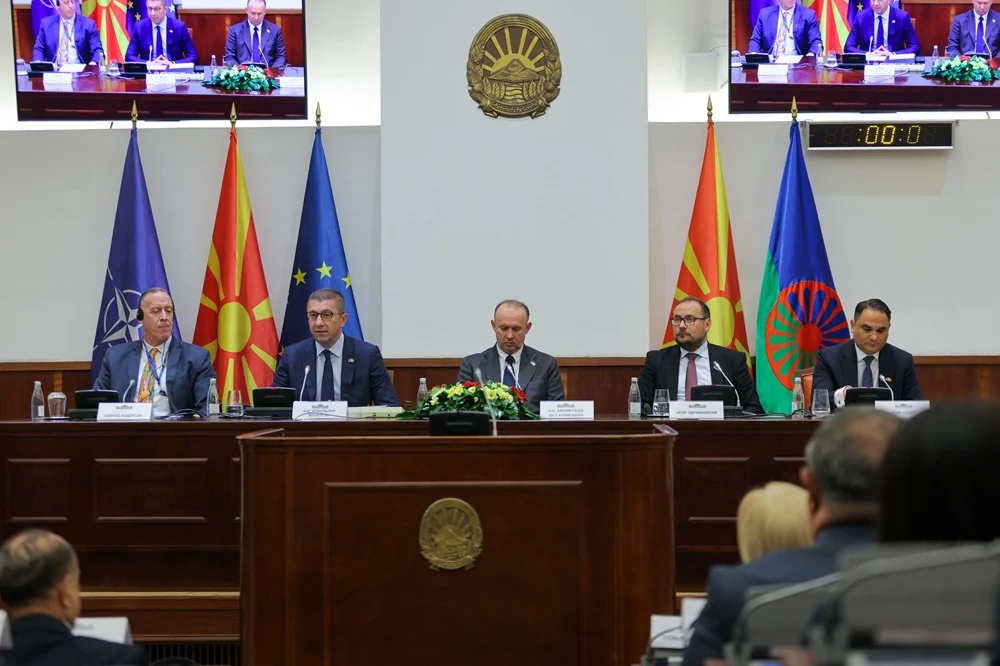
Macedonia marked International Roma Day on April 8 with a series of messages from senior state officials who said the day should not remain only symbolic, but should serve as a reminder of the need for concrete action to improve the position of the Roma community. Prime Minister Hristijan Mickoski said the day is not only about words but also about decisions, vision, and courage, while Assembly Speaker Afrim Gashi said Roma citizens are an inseparable part of society and deserve the same rights, dignity, and opportunities as all others. President Gordana Siljanovska-Davkova, in her message, said the Roma community deserves more than declarative rights and called for greater attention, concrete policies, and real institutional protection.
The central message: progress exists, but exclusion remains deep
The overall tone of the commemorations was that legal and political progress has not been enough to eliminate the everyday barriers that Roma people still face. Gashi said that despite advances in legislation, many Roma continue to encounter discrimination and obstacles in access to education, employment, and basic services. Siljanovska-Davkova described Roma as the most vulnerable and marginalized category of citizens, while CivilMedia’s broader coverage framed the day as one shaped not only by culture and identity, but by a continuing struggle against discrimination, poverty, and systemic injustice.
Employment remains one of the sharpest indicators of inequality
One of the clearest statistical warnings highlighted in the coverage was unemployment. The reports said unemployment among the Roma population stands at 67 percent, presenting this as one of the most serious signs of the persistent socioeconomic gap between Roma citizens and the rest of society. In that context, official statements linked Roma inclusion not only to rights and recognition but also to the need for policies that would produce visible change in access to jobs, services, and social mobility.
Education is presented as the starting point for real inclusion
Mickoski placed particular emphasis on education, saying the government’s vision for real equality begins with access to schooling for every Roma child. According to the reports, he said inclusion must start in schools where there is no division but opportunity and presented education as the foundation for long-term integration. His message tied the issue of Roma rights directly to public policy, arguing that human dignity stands above daily politics and that behind every statistic, an individual story and a hope are waiting to be recognized and supported.
Parliament speaker calls for a more coordinated and braver response
Gashi’s message was broader in institutional scope, arguing that the country needs a more coordinated, sustainable, and bolder approach to Roma equality. He said the theme “From invisibility to equality” underlines the need for real opportunities, representation, and respect for dignity, and called for stronger institutional coordination, political will, civic engagement, and media responsibility. He also urged the executive branch to do more to expand opportunities for education, employment, and public representation for Roma citizens, framing the issue as one that requires action from the whole institutional system rather than isolated gestures.
Presidency warns against limiting rights to symbolic declarations
President Siljanovska-Davkova’s message focused on the gap between formal recognition and real protection. According to the reports, she said the Roma community deserves more than rights that exist only on paper and stressed that institutions must move from declarations to practical guarantees. Her greeting to Roma citizens combined ceremonial wishes with a direct call for shared responsibility in improving their position, making clear that the burden should not rest on the community alone, but also on state institutions and society as a whole.
Public discourse also highlights culture, identity, and historical visibility
Beyond official statements, the day was also framed as one of cultural affirmation and recognition of Roma identity. CivilMedia’s coverage emphasized that April 8 is not only a date for institutional messages but also for acknowledging Roma culture, historical presence, and the long continuity of their struggle for equal treatment. In that framing, the celebration of identity and the exposure of injustice were treated as inseparable, with the reports arguing that the central problem is not the Roma community itself, but the system that continues to discriminate and marginalize.
A day of recognition, but also a reminder of unfinished obligations
Taken together, the reports portray this year’s International Roma Day in North Macedonia as a moment of simultaneous recognition and warning. State leaders publicly affirmed that Roma citizens deserve equality, dignity, and stronger protection, while the accompanying statistics and commentary showed how far the country still is from achieving those goals in practice. The recurring message across the coverage was that April 8 should not end with ceremonial language alone, but should translate into better education access, lower unemployment, stronger protection from discrimination, and policies capable of turning formal rights into real change.