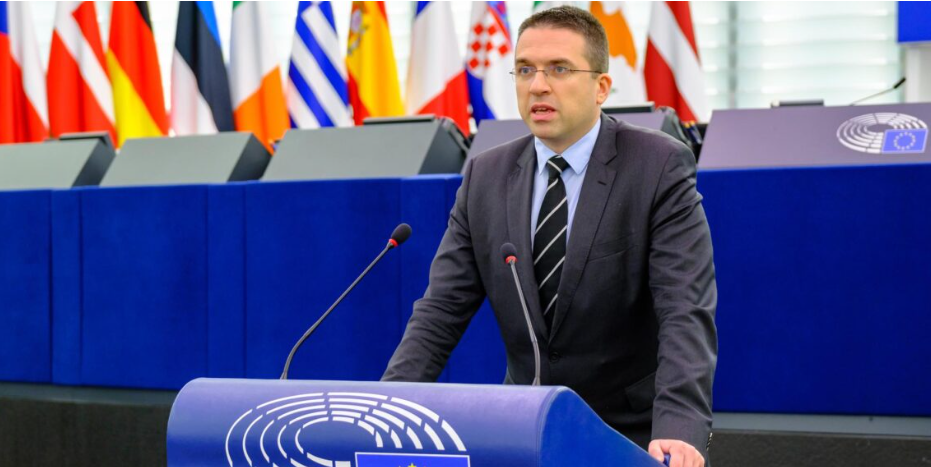
Croatian Member of the European Parliament Tomislav Sokol has called for a tougher European Union approach toward Serbia, arguing that Brussels should reassess its financial support to Belgrade unless there are deeper political changes in the country.
Speaking to Croatia’s N1 television, Sokol, a member of the ruling HDZ and the European People’s Party, said Serbia remains a source of political instability in the region. He argued that the EU should consider building what he described as a “cordon sanitaire” around Serbia in order to limit the influence of political currents he considers dangerous and strongly pro-Serbian in orientation.
Sokol’s remarks followed earlier comments by European Parliament rapporteur for Serbia Tonino Picula, who described the government of Serbian President Aleksandar Vučić as a destabilizing factor both inside Serbia and in the wider region. Sokol said he agreed with that assessment, claiming that nationalist ideas continue to have a strong influence on Serbian politics.
He also criticized what he sees as the EU’s long-standing tolerance toward Belgrade, saying Brussels has been too lenient toward what he described as an increasingly authoritarian style of government. According to Sokol, the EU should not continue treating the region as a place where financial assistance is provided without clear political conditions.
The Croatian MEP was also critical of Serbia’s media and political environment, arguing that the influence of nationalist narratives extends beyond the ruling authorities. He suggested that parts of the opposition do not offer a substantially different political direction.
Turning to the wider region, Sokol singled out Montenegro as a country that should be given a clearer European path. He warned that Montenegro should not be allowed to fall under strong external political influence and said the EU must make a clearer distinction between reliable partners and countries that create political challenges.
His comments reflect growing debate inside the EU over how to balance enlargement policy with concerns about democratic standards, regional stability and foreign influence in the Western Balkans.