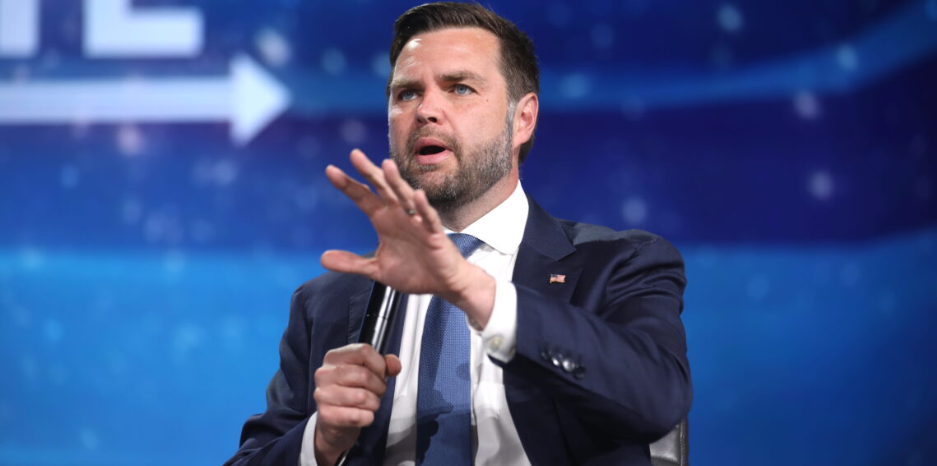
U.S. Vice President J.D. Vance has again placed himself at the center of a heated foreign policy debate after praising the Trump administration’s decision to end direct weapons deliveries to Ukraine.
Speaking at an event organized by Turning Point, Vance said Washington was changing its approach to military assistance. Under the new policy, the United States would no longer send weapons directly to Kyiv. Instead, European countries would be able to purchase American arms and transfer them to Ukraine themselves.
Vance presented the move as a more balanced and realistic strategy, arguing that Europe should take greater responsibility for security on its own continent. But critics in Washington and abroad say the decision risks weakening Ukraine at a critical stage of the war, as Russia continues to target Ukrainian cities and energy infrastructure.
Congresswoman Marcy Kaptur was among those who strongly criticized the shift, warning that reducing direct U.S. support could ultimately benefit the Kremlin. According to critics, limiting Washington’s direct role could affect the military balance on the ground and send a message of hesitation to both allies and adversaries.
Vance’s role in the Ukraine debate appears to go beyond public messaging. According to people familiar with discussions inside the administration, he has become an influential voice in shaping U.S. policy toward the war. In internal White House debates, he is seen as one of the figures pushing for a more restrained American role.
His skepticism toward Ukraine is not new. Before becoming vice president, Vance repeatedly questioned the scale and purpose of U.S. assistance to Kyiv. In 2022, during the early phase of Russia’s full-scale invasion, he made controversial remarks suggesting that Ukraine was not a central concern for him, a statement that later became closely associated with his broader criticism of U.S. involvement.
For Vance, the war in Ukraine is often framed less as a defining American security priority and more as an example of foreign policy overreach. He has criticized the level of military and financial support approved under the Biden administration and has argued that European NATO members should carry a larger share of the burden.
Still, the issue is not viewed the same way even within circles close to him. His cousin, Nate Vance, reportedly traveled to Ukraine after the start of the war, first as a humanitarian volunteer and later as a fighter alongside Ukrainian forces. His experience on the front lines stands in sharp contrast to the vice president’s political position.
There are also differences inside the wider administration. Army Secretary Daniel Driscoll, described as a longtime ally of Vance, has publicly emphasized cooperation with Ukraine’s military and has taken part in contacts with Ukrainian officials. His position highlights the fact that the administration’s approach to Ukraine is not entirely uniform.
Inside the White House, Vance is described as part of the team involved in discussions over possible peace efforts. Officials say he participates in meetings linked to negotiations and remains an important voice in shaping the administration’s thinking on how the war should end.
Analysts caution, however, that Vance’s worldview should not be reduced simply to isolationism. Some argue that he takes a selective approach to U.S. interests abroad, supporting American engagement in certain areas, such as Israel or Taiwan, while strongly opposing deeper involvement in Ukraine.
European observers also see a domestic political calculation in his rhetoric. By taking a tougher line on Ukraine aid, Vance appeals to voters on the American right who are increasingly skeptical of long-term foreign military commitments. In that sense, Ukraine has become not only a foreign policy issue, but also a major part of U.S. political positioning.
Behind his approach, some analysts see a broader strategic goal: reducing direct American military involvement in the conflict and leaving room for a possible diplomatic reset with Moscow. Whether that strategy can produce peace, or whether it will be interpreted as a weakening of Western resolve, remains one of the central questions facing Washington and its allies.