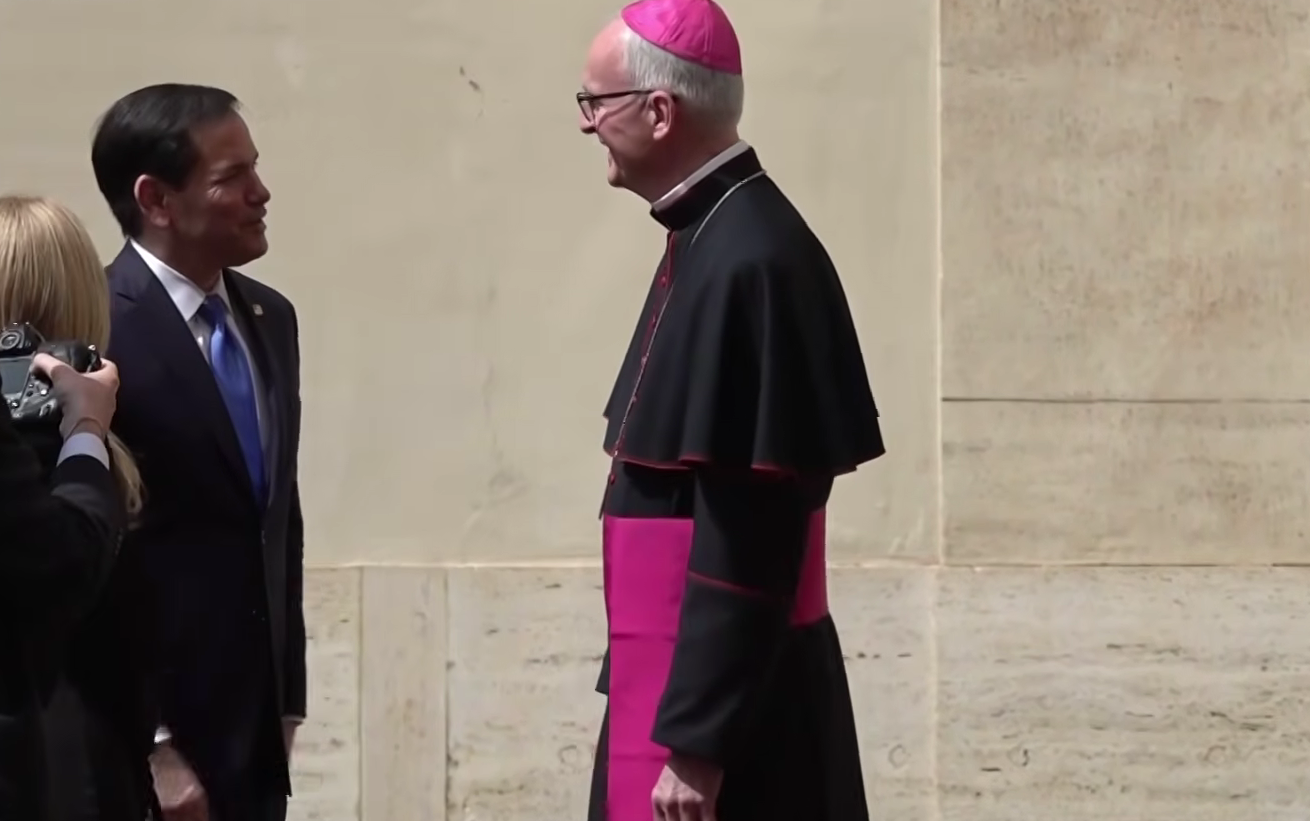
U.S. Secretary of State Marco Rubio arrived at the Vatican on Thursday for a delicate fence mending mission after President Donald Trump’s public attacks on Pope Leo XIV over the Iran war and immigration policies sparked an unprecedented diplomatic crisis between Washington and the Holy See. The visit, requested by Washington and accepted by the Vatican despite tensions, became immediately complicated when Trump renewed his criticism just hours before Rubio’s meeting with the Chicago born pope, accusing Leo of being “OK” with Iran obtaining nuclear weapons, a claim the pope flatly rejected by stating the Catholic Church has “for years spoken out against all nuclear weapons” and that his mission is simply “to preach the Gospel, to preach peace.” Cardinal Pietro Parolin, the Vatican secretary of state, defended Leo in unusually direct diplomatic language on the eve of Rubio’s arrival, calling Trump’s attacks “a bit strange, to say the least,” while acknowledging that “despite some difficulties, they certainly remain a key partner for the Holy See.”
The confrontation began when Trump lashed out at Leo on social media last month over comments criticizing the administration’s deportation policies and the Iran war, prompting the pope to respond that “God doesn’t listen to the prayers of those who wage war.” Trump then posted an image appearing to compare himself to Jesus Christ, which was deleted after backlash, and he has refused to apologize while claiming he thought the image showed him as a doctor. Rubio, a practicing Catholic who has frequently been tasked with softening Trump’s rhetoric, insisted the visit had been planned before the flare up but admitted “obviously we had some stuff that happened,” while framing Trump’s anger as rooted in opposition to Iranian nuclear weapons that could threaten millions of Christians. Yet Italian commentators suggest Rubio’s motives extend beyond conciliation, with former ANSA head Giampiero Gramaglia telling the Foreign Press Association that “Rubio’s mission is more about himself” and his potential 2028 presidential ambitions as a prominent Catholic Republican.
The broader context reveals a transatlantic rift deepening by the day. Italian Premier Giorgia Meloni and Foreign Minister Antonio Tajani, whom Rubio is scheduled to meet Friday, have both strongly defended Leo and criticized the Iran war as illegal, positions that drew Trump’s anger and his announcement of plans to withdraw thousands of troops from Germany. The Vatican is also alarmed by Trump’s repeated threats that Cuba could be “next” after the removal of Venezuelan President Nicolás Maduro, with the president suggesting Middle East naval assets could return via Cuba once the Iran war ends. This illustrates how Trump’s personal grievances are fracturing alliances that have endured for decades, forcing even senior cabinet members into damage control roles that serve their own political futures as much as American diplomacy. Whether Rubio can restore functional relations with the Vatican remains doubtful when the president who sent him continues to escalate the very conflict that made the mission necessary.