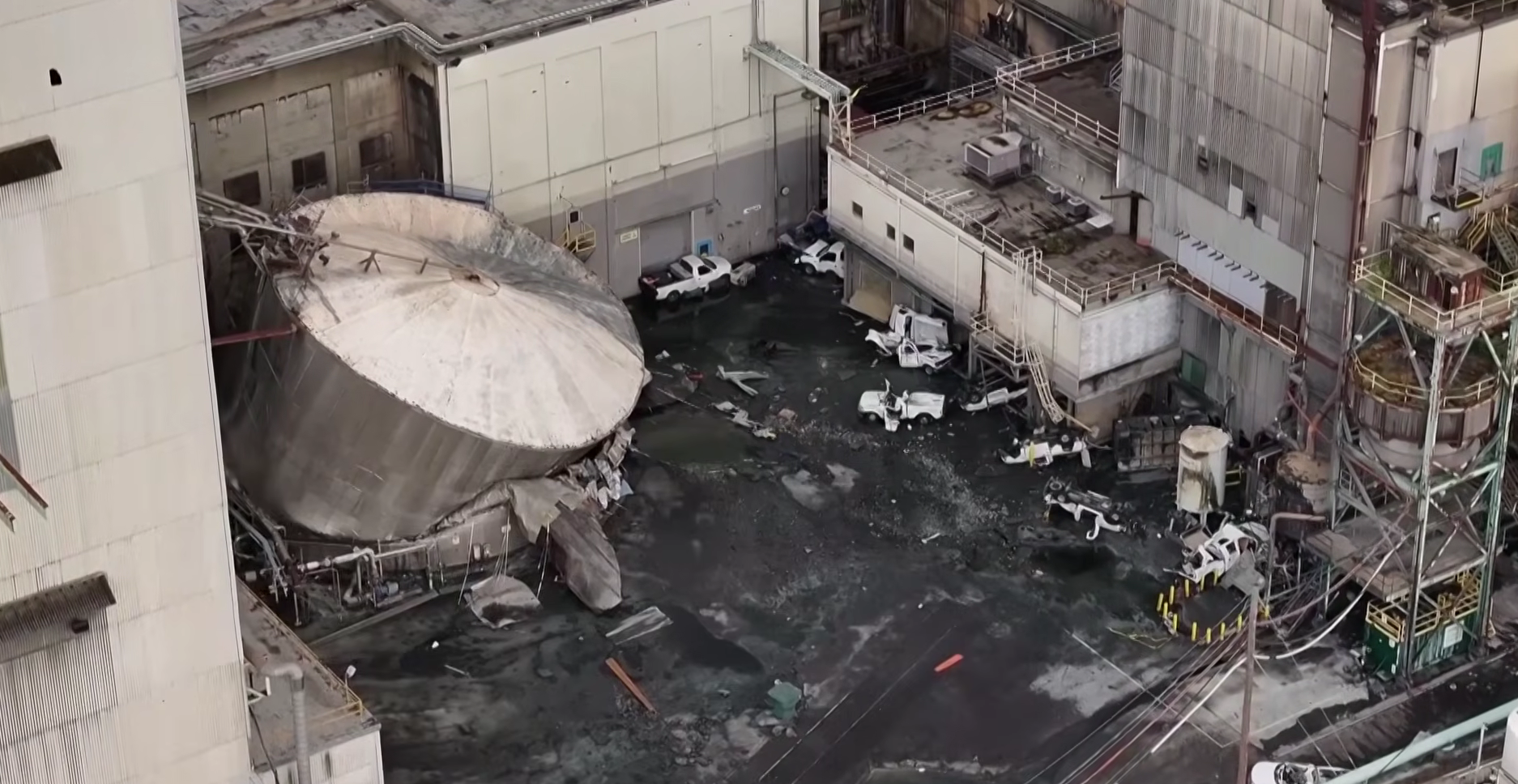
A catastrophic chemical tank implosion at the Nippon Dynawave Packaging plant in Longview, Washington, has left two people confirmed dead and nine others presumed dead, with officials declaring on Wednesday that rescue operations have shifted to recovery. The blast, which occurred at approximately 7:15 a.m. on 26 May, involved a 900,000 gallon spherical tank of “white liquor”, a highly caustic mixture of sodium hydroxide, sodium sulfide, and disodium carbonate used in the paper pulping process. The tank was roughly 60% full at the time, and officials estimate that 550,000 to 570,000 gallons of the noxious brew escaped, contaminating a nearby drainage ditch and the Columbia River. Governor Bob Ferguson called the incident the “deadliest industrial tragedy in modern Washington state history,” warning of profound impacts on individuals, families, and communities.
The timing of the disaster magnified its human toll. A shift change had begun roughly 15 minutes before the blast, meaning the area, which included administrative workspaces, a break room, and operational zones, was crowded with employees. Among the victims was Gilbert Bernal, 52, a father and grandfather who was initially taken to hospital in critical condition but died shortly after. His son Eli, also a plant worker, described arriving to find “a big steam cloud, it was everywhere, just like a cloud on the floor.” Seven other employees remain hospitalized with injuries ranging from chemical burns to inhalation trauma, while an injured firefighter was treated and released. Recovery efforts have been painstakingly slow due to the structural instability of the ruptured tank, which still holds an estimated 90,000 gallons of white liquor, and the need to decontaminate bodies before they can be transported to the Cowlitz County coroner for identification. Forty six members of the Washington National Guard, including civil support teams for air monitoring and a homeland response force for decontamination, have been deployed to assist.
The environmental and regulatory fallout is only beginning. The Washington Department of Ecology confirmed that white liquor entered the Columbia River, though testing has so far indicated no threat to Longview’s municipal water supply, about a dozen dead carp were recovered from a river dike. The state Department of Labor and Industries revealed that multiple inspections of the Nippon Dynawave facility remain open, including one involving a valve on an aqua ammonia clarifier tank and another opened this month after a complaint about a sinkhole created by a failed drain. While past citations at the plant were unrelated to chemical storage safety, ranging from a $700 fine for missing guardrails to a $2,700 COVID era mask violation, regulators had not flagged the white liquor tank as a current concern. The U.S. Chemical Safety and Hazard Investigation Board has opened an independent federal probe, and the state Ecology Department is evaluating the full scope of the spill. Nippon Dynawave, a subsidiary of Tokyo based Nippon Paper Industries that employs roughly 1,000 people in Longview, has not commented publicly. For a community whose identity has been intertwined with timber and paper since the 1920s, the disaster raises urgent questions about whether industrial heritage can coexist with modern safety standards, and whether the regulatory framework designed to protect workers was adequate for a tank the size of one and a half Olympic swimming pools.