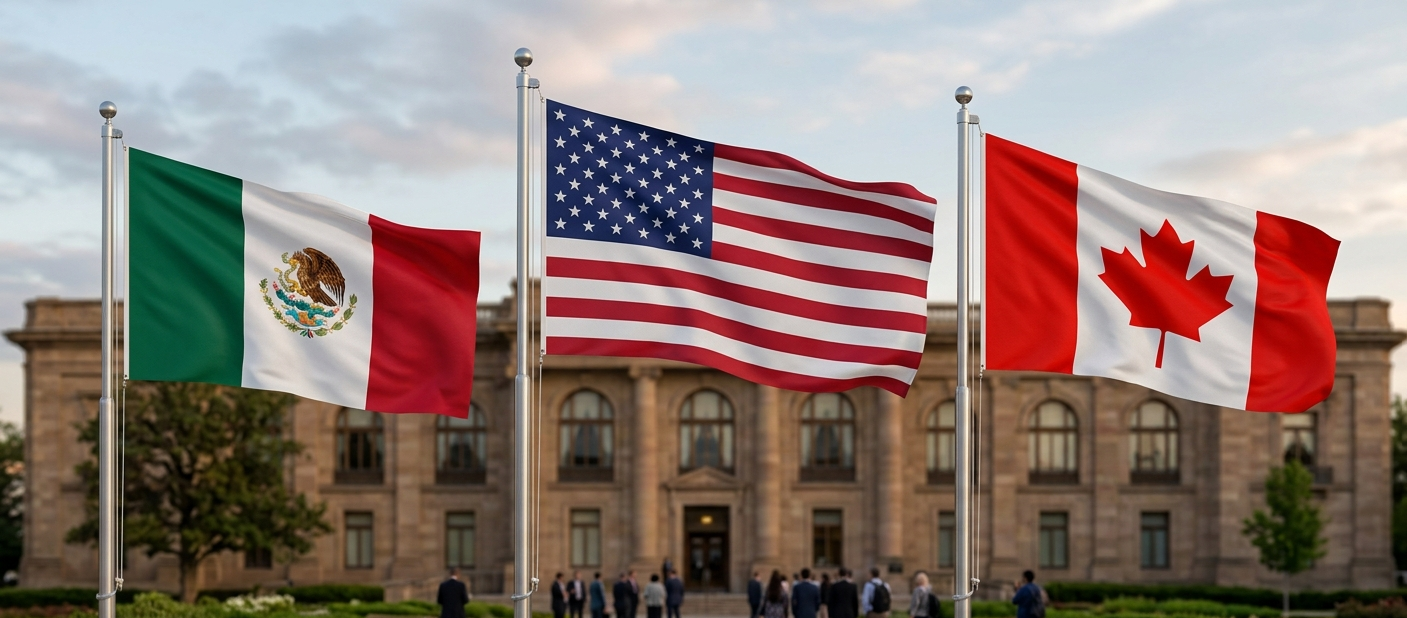
The Trump administration has declined to renew the US-Mexico-Canada Agreement (USMCA), starting a decade long clock toward the trade pact’s potential termination while opening negotiations aimed at reshaping North American commerce to favor American manufacturing. The decision, announced on July 1, 2026, following the agreement’s mandatory six year joint review, keeps the deal in force for another 10 years with annual reviews but signals a fundamental shift in Washington’s approach to its two largest trading partners. “The United States did not agree to renew the USMCA in its current form,” US Trade Representative Jamieson Greer stated in an official release. “The United States will continue to engage with Mexico and Canada to address the Agreement’s shortcomings and our trade deficits with these countries.”
The administration’s grievances center on persistent trade imbalances and perceived loopholes that have allowed manufacturing to migrate south of the border. US goods trade deficits with Mexico and Canada reached $197 billion and $48.3 billion respectively in 2025, with much of the Mexican deficit driven by companies shifting supply chains from China to take advantage of USMCA’s tariff free access. Greer told a House Ways and Means Committee hearing in May that the agreement’s shortcomings were “such that a rubberstamp of the Agreement is not in the national interest,” and that some US manufacturers continued to locate facilities in Canada and Mexico to access imported inputs without paying US tariffs. The US will proceed with a third round of bilateral negotiations with Mexico scheduled for the week of July 20 in Mexico City, focusing on strengthening North American rules of origin for autos and other industrial goods to prevent China from benefiting from USMCA access.
The negotiating positions reveal deep divisions that could reshape the $1.6 trillion trilateral trading relationship. The Trump administration has demanded that North American built vehicles contain 50% US content, pushing the regional total to 82%, a requirement that Mexican Economy Minister Marcelo Ebrard warned would put Mexico’s automotive industry at a “disadvantage.” Ebrard, who participated in Wednesday’s virtual meeting with Greer and Canadian minister Dominic LeBlanc, insisted that “there is no difference… so big that we cannot resolve it,” but acknowledged that protecting Mexico’s auto sector has been “the main point of discussion.” LeBlanc, for his part, emphasized Canada’s commitment to addressing Trump’s tariffs on Canadian steel, aluminum, autos, and lumber while working to ensure trade frameworks “continue to support North American prosperity and competitiveness.” The senior administration official told reporters that Trump, who has already imposed 25% tariffs on Mexican and Canadian autos, 50% on metals, and 10% on lumber, remains skeptical of any deal and would likely continue using unilateral tariff pressure regardless of negotiation outcomes.
Industry and agricultural groups have pushed back hard against the prospect of USMCA’s demise. The Agricultural Coalition for USMCA, representing corn and soybean growers to distillers and meatpackers, called the agreement “without a doubt critical to the livelihood of farmers, fishers and rural communities,” noting that Mexico and Canada together purchase more than a third of US agricultural exports. Nissan CEO Ivan Espinosa warned that stricter content requirements could worsen affordability for American car buyers: “you cannot build all the parts in the US. The supply chain is not set up to do that. We need something that is actually executable.” The paradox at the heart of Trump’s approach is unmistakable, he negotiated and championed USMCA in 2020 as “the best agreement we’ve ever made,” only to declare that the US would do better without it. For North American businesses that have spent six years aligning supply chains to USMCA rules, the next decade promises uncertainty, annual reviews, and the persistent threat that the framework underpinning their operations could simply vanish, replaced not by a better deal, but by a patchwork of bilateral protocols and punitive tariffs.